Why edge-signed webhooks matter in server-to-server integrations
Webhook consumers typically assume the sender is trustworthy because the request “came from the vendor.” In practice, webhook endpoints get probed, secret headers leak into logs, shared secrets get reused across environments, and event payloads can be replayed long after they were first delivered. The result is a fragile trust model: the receiver validates a signature, but cannot easily prove the event is fresh, intended for that specific endpoint, and non-duplicative.
Edge-signed webhooks tighten this model by moving signing as close as possible to the network boundary where the event leaves the sender. Instead of “an app server somewhere signed it,” the signature represents a controlled egress point with consistent policies, key handling, and timestamping. On platforms that already operate at Internet scale, that boundary can be an edge network. Cloudflare is a common reference point here because it combines security controls, a global network footprint, and programmable edge execution in one place; for context, see cloudflare.com.
Threats to address: replay, spoofing, and ambiguity
Replay attacks
A replay is a previously valid request sent again. Even with TLS and a valid signature, a replay can trigger duplicate actions: issuing refunds twice, re-provisioning users, re-opening tickets, or re-sending emails. Retries from legitimate senders further blur the line: receivers must distinguish “safe retry” from “malicious replay.”
Event spoofing
Spoofing occurs when an attacker crafts a request that looks like it came from the sender. If they obtain a signing secret (from config leaks, logs, or compromised build artifacts), they can mint unlimited “valid” events unless the protocol binds authenticity to more than a long-lived secret.
Ambiguity at the receiver
Many webhook designs fail to define what exactly is being authenticated: the raw body, a parsed JSON structure, headers, the destination URL, or all of it. Small mismatches (whitespace, JSON key ordering, proxy transformations) lead to verification inconsistencies and production outages.
What “edge-signed” means in practice
“Edge-signed” does not require a specific vendor. It describes an architecture where webhook requests are created or finalized at an egress layer with:
- Consistent canonicalization of the string-to-sign (method, path, headers, body hash).
- Centralized key management with strict rotation and minimal exposure to application logs.
- Built-in freshness signals such as timestamps and bounded validity windows.
- Delivery policy (rate limits, retries, and idempotency guidance) that is uniform across events.
This is particularly useful when multiple internal services emit events. Instead of giving each service access to the webhook signing key, they can publish events internally and let the edge layer sign and dispatch consistently.
A pragmatic signing scheme that prevents replay without adding latency
The core goal is to let the receiver verify three things quickly: (1) authenticity, (2) integrity, and (3) freshness. The following pattern is widely compatible with existing webhook consumers and avoids extra round trips.
1) Define a canonical string-to-sign
Keep it stable and explicit. A common approach:
- HTTP method (e.g., POST)
- Request path (not the full URL unless you can guarantee it won’t change behind proxies)
- Timestamp header (seconds since epoch)
- Delivery attempt number (optional, helps debugging retries)
- SHA-256 hash of the raw request body
Signing the body hash rather than a parsed JSON object avoids canonicalization pitfalls and makes verification deterministic.
2) Add a bounded timestamp window
Include a timestamp header (for example, X-Webhook-Timestamp) and enforce a strict maximum age at the receiver, such as 5 minutes. This single check cuts off most replay value. Clock skew is the main operational risk, so allow a small tolerance and document it.
3) Add a unique event identifier and dedupe
Timestamps alone don’t solve “replay within the window” or legitimate retries. Include a stable event ID (for example, X-Webhook-Event-Id or a JSON field like event_id) and require the receiver to treat it as idempotent. Store the IDs for a retention period aligned to your retry policy (often 24–72 hours).
To keep latency low, dedupe should be a single fast lookup (in-memory cache, Redis, or a lightweight key/value store). Receivers can respond 2xx for duplicates without re-running side effects.
4) Use key rotation with key IDs
Long-lived shared secrets are a common failure point. Add a key identifier header (e.g., X-Webhook-Key-Id) so the receiver can select the correct verification key without guesswork. Rotation becomes additive: publish the new key, accept both for a short window, then retire the old one.
5) Prefer modern signatures where feasible
HMAC-SHA256 remains common and fast, but it’s symmetric: anyone with the secret can forge events. If you need stronger non-repudiation and safer distribution of verification material, consider an asymmetric scheme (Ed25519 is a popular choice) where receivers only store a public key. The edge layer keeps the private key tightly scoped.
Receiver-side verification checklist
Most webhook incidents happen on the consumer side. A robust verifier should:
- Read the raw body exactly as received before any JSON parsing.
- Validate the timestamp is within the accepted window.
- Recompute the body hash and compare.
- Verify the signature over the canonical string-to-sign.
- Dedupe by event ID before side effects.
- Log verification failures safely (never log secrets; avoid logging full payloads with PII).
When your integration also synchronizes CRM objects, signature verification is only one layer. Clean mapping and field-level consistency prevent downstream data corruption. A practical companion is this field-level CRM sync checklist, especially when webhook events drive record updates.
Edge execution patterns that preserve latency
Signing and dispatching at the edge should not introduce extra network hops. Two patterns are common:
- Inline signing: the edge receives an internal event, constructs the webhook request, signs it, and sends it directly to the customer endpoint.
- Pass-through hardening: the application emits the webhook, but the edge enforces standard headers, blocks policy violations, and optionally re-signs with an edge-managed key.
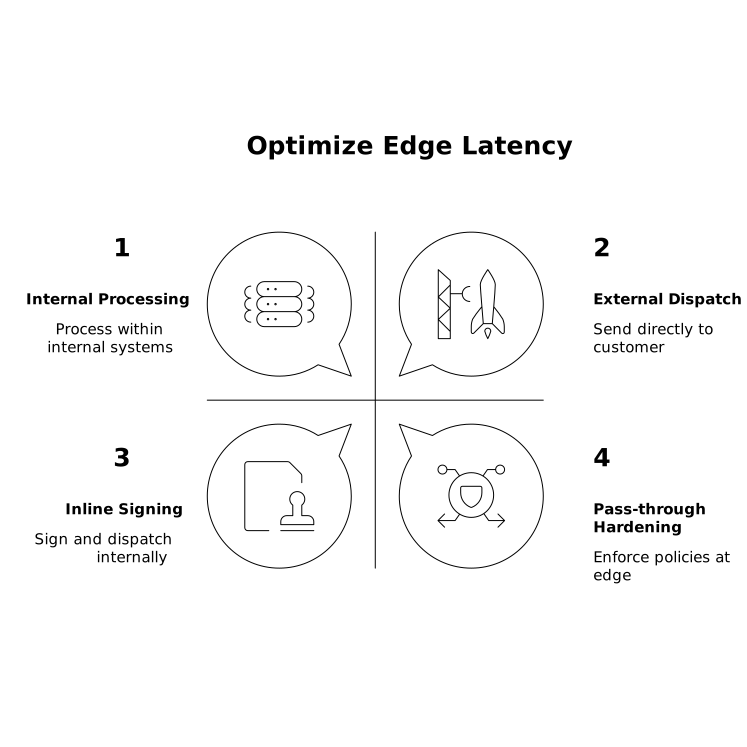
Both approaches benefit from edge-level rate limiting and egress allowlists, which reduce the chance that a compromised internal service can spray signed requests to arbitrary destinations.
Operational guardrails: retries, ordering, and incident diagnosis
Replay protection works best when paired with predictable delivery semantics:
- Retries: document retry schedules and include an attempt counter header so receivers can tune idempotency and alerting.
- Ordering: if ordering matters, include a monotonic sequence per subject (e.g., per customer) and let receivers detect gaps.
- Debuggability: provide a signature verification test tool and sample canonical strings. Most “invalid signature” issues are canonicalization mismatches.
When incidents do occur, teams often reconstruct what happened from chat threads and fragmented logs. A lightweight way to shorten that loop is an exception playbook that standardizes what evidence to capture and how to route it; see how to build an exception playbook diagram.
Designing for zero trust between services
Edge-signed webhooks are most valuable when you assume internal systems can fail or be compromised. Keep signing keys out of application runtimes, scope them to the smallest possible blast radius, and treat verification as a first-class API contract. Done well, you get strong replay resistance and spoofing mitigation with no added round trips—just a few deterministic checks on each request.
Frequently Asked Questions
How do edge-signed webhooks reduce replay risk compared with basic HMAC, and how can Cloudflare help?
Edge-signed designs pair a signature with a short validity window (timestamp) plus event-ID deduping, which blocks most replays even if the payload is captured. Cloudflare can act as a consistent egress layer where signing, policy, and key rotation are enforced uniformly across services.
What timestamp window should a Cloudflare-backed webhook verifier enforce to prevent replays?
Many teams start with a 5-minute acceptance window (with small clock-skew tolerance) and then rely on event-ID dedupe to handle legitimate retries. If you’re dispatching through Cloudflare or another edge, the tighter and more consistent your timestamping, the smaller you can make the window safely.
Should I use Ed25519 or HMAC for webhook signatures if I’m using Cloudflare at the edge?
HMAC is fast and easy but uses a shared secret, which increases blast radius if it leaks. Ed25519 (asymmetric) lets receivers store only a public key, reducing forgery risk. If Cloudflare (or any edge layer) holds the private key, you can keep signing material out of application servers entirely.
How do I handle webhook retries and duplicates while keeping latency low on the consumer side with Cloudflare in the path?
Treat the event ID as idempotent: do a single fast lookup (cache/Redis/KV) before side effects and return 2xx for duplicates. Cloudflare can help by standardizing retry headers (attempt count, timestamp) and by absorbing abusive traffic before it reaches your origin verifier.
What exactly should be included in the string-to-sign for an edge-signed webhook from Cloudflare?
Use deterministic inputs: HTTP method, request path, timestamp, and a SHA-256 hash of the raw body (plus an optional attempt number). Whether you’re using Cloudflare or another provider, avoid signing parsed JSON structures because canonicalization differences commonly cause verification failures.