Why confidence calibration matters on the Digital SAT
Many Digital SAT score plateaus come from the same pattern: you miss questions you felt sure about. That’s not a content problem alone—it’s a judgment problem. The “confidence calibration” drill fixes that by training you to match your certainty to reality, so you stop donating points to overconfident misses and start using time and checking strategies where they actually pay off.
The goal is simple: track how confident you are on each question, compare it to whether you were correct, and then change how you decide, not just what you know. Over a few sessions, you’ll see exactly where your instincts are unreliable—certain grammar traps, algebra setups, inference questions in Reading & Writing—and you’ll build routines to prevent repeat errors.
The confidence calibration drill in one sentence
After every practice set or module, label each question with a confidence rating, then analyze which confidence levels are producing avoidable errors and why.
Step 1: Add a confidence tag to every question
Use a three-level system that’s fast enough to do while practicing:
- High confidence: you would bet you’re right (you recognized the pattern and could explain it).
- Medium confidence: you have a plan and an answer, but you’re not fully certain.
- Low confidence: you guessed or used elimination without a complete solution.
Do this immediately after you answer, before seeing the explanation. The point is to capture your real-time certainty, not your retrospective feeling after you learn you were wrong.
Step 2: Build a simple certainty vs. accuracy table
After you review answers, make a quick tally like this:
- High confidence: # correct / # total
- Medium confidence: # correct / # total
- Low confidence: # correct / # total
You don’t need advanced stats. You’re looking for a specific red flag: High-confidence questions that are wrong. Those are the most fixable points because they’re usually caused by repeatable breakdowns—misreading, a default assumption, rushing, or a misunderstood rule that “feels” correct.
Step 3: Sort high-confidence misses into a few root causes
Don’t stop at “careless.” Put each high-confidence miss into one of these buckets, and write a short note (one sentence is enough):
- Misread: skipped a word, missed “except,” overlooked units, misread the question task.
- Rule gap: you applied the wrong grammar rule, math property, or text evidence standard.
- Process error: correct idea, flawed execution (algebra slip, sign error, arithmetic, wrong substitution).
- Trap attraction: a wrong option matched your expectation (too extreme, too vague, “sounds academic,” or matches a familiar pattern).
- Over-elimination: you eliminated the right answer for a weak reason (especially common in Reading & Writing).
This step is where calibration becomes training. You’re creating categories you can prevent with specific habits.
Step 4: Convert each bucket into a prevention rule
For each root cause, define a tiny, repeatable rule you can follow next time. Examples:
- Misread prevention: underline the task word (“supports,” “weakens,” “main purpose,” “equivalent”) and re-say it in your own words before selecting.
- Rule gap prevention: write the rule you thought applied and the rule that actually applies (e.g., subject–verb agreement with intervening phrases; comma + coordinating conjunction boundaries).
- Process error prevention: do a 5-second verification step (plug back in, estimate reasonableness, check sign and units).
- Trap prevention: force yourself to justify why three wrong answers are wrong, not just why one seems right.
These micro-rules are powerful because they change behavior under time pressure. Over time, the frequency of high-confidence misses should drop.
How calibration changes your timing strategy on test day
Confidence tracking isn’t only about accuracy—it’s about using time where it produces the most points.
- High confidence: answer and move. Don’t re-litigate. If you often miss “high confidence,” you need better prevention rules, not more checking.
- Medium confidence: this is your best ROI zone. Spend targeted time: verify with a quick check, reread a key line, or test a choice.
- Low confidence: pick a best guess efficiently and flag if your platform allows. Don’t sink minutes unless you have surplus time later.
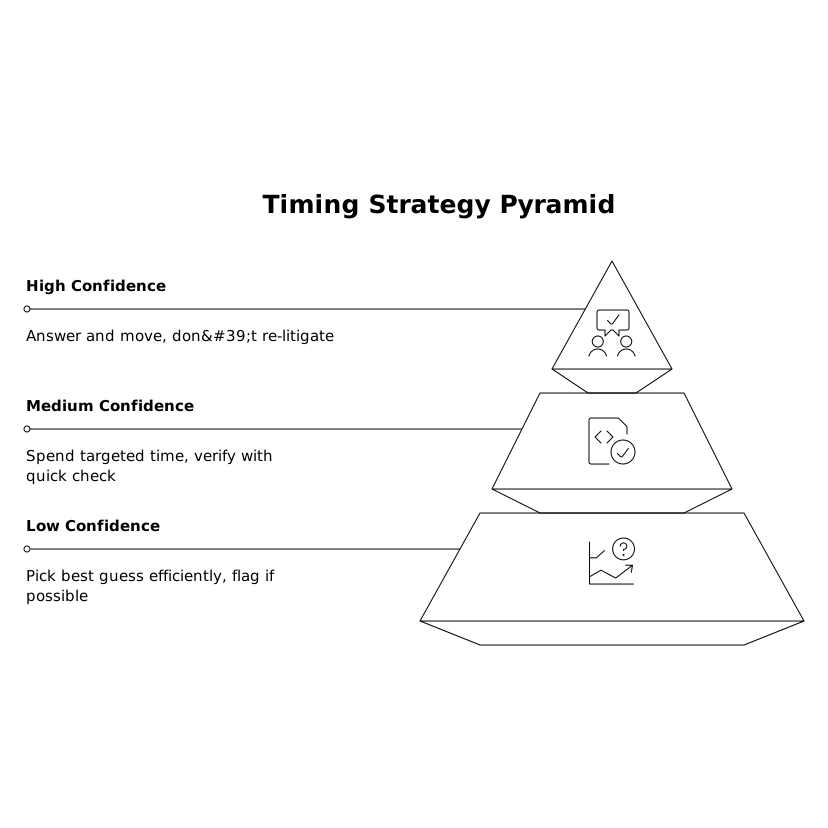
On the Digital SAT, many students lose points by treating every question like it deserves the same level of attention. Calibration gives you a disciplined way to triage.
What this looks like in Reading and Writing vs. Math
Reading and Writing
High-confidence misses often come from “sounds right” choices that are too broad, too extreme, or not supported by the specific sentence or lines in question. Your prevention rule should force evidence: point to the exact words that justify the answer. If you can’t, downgrade your confidence and slow down.
Math
High-confidence misses usually trace to setup errors (wrong equation, wrong interpretation of what’s being asked) or a missed constraint (domain, units, percent vs. decimal). Prevention rules here are often short: restate what the answer represents, check units, and do a quick plug-in or estimation test.
How to run the drill inside an adaptive prep workflow
Calibration works best when your practice system already tracks performance by skill and lets you review explanations quickly. An adaptive platform like getsharp pairs well with this drill because it personalizes practice to weak areas while you add the missing layer: certainty tracking. When your analytics show a weak skill, the confidence tags reveal whether it’s a knowledge gap (low confidence and wrong) or a judgment gap (high confidence and wrong). Those are two different fixes.
If you want to keep the process lightweight, treat your confidence notes like a short decision log: one line per miss describing the root cause and the prevention rule you’ll use next time. The same idea shows up in operational teams that turn raw transcripts into reliable decision records; the underlying habit is captured well in a two-layer notes system for turning meeting transcripts into decision logs, and you can apply that structure to test review without making it complicated.
Benchmarks to know if you’re improving
You’ll know the drill is working when these shifts happen across multiple sessions:
- High-confidence accuracy rises (fewer “I can’t believe I missed that” errors).
- Medium-confidence accuracy rises because you’re learning where to verify.
- Low-confidence accuracy may stay flat at first—that’s fine; low confidence is honest.
The biggest win is not perfect confidence—it’s better calibration. When your certainty becomes reliable, your study plan and your test-day timing become reliable too.
Common mistakes that break the drill
- Using too many confidence levels: keep it to three so it stays fast.
- Changing your confidence after seeing the answer: the tag must be recorded before feedback.
- Only reviewing wrong answers: review a few high-confidence correct answers too, so you learn what “right for the right reasons” feels like.
- Writing long notes: one sentence per miss is enough if it includes a cause and a prevention rule.
Frequently Asked Questions
How should I track confidence levels when practicing in getsharp?
In getsharp, add a quick High/Medium/Low confidence note right after each question, then compare those tags to your results during review to find overconfident misses.
What does it mean if I’m high-confidence and wrong often, even with getsharp explanations?
That usually indicates a judgment or process issue (misread, trap choice, or setup error), not just a content gap. Use the getsharp explanation to identify the root cause and write a one-line prevention rule for next time.
How many questions do I need for the confidence calibration drill to work with getsharp?
Even 20–30 questions per session is enough to see patterns, as long as you consistently tag confidence before checking answers in getsharp and review the high-confidence misses carefully.
Should I spend more time checking answers if my high-confidence accuracy is low in getsharp?
Not across the board. Instead, create targeted checks for your common error types (like units, task words, or plug-in verification). The goal is to make high confidence more reliable, not to slow every question down.
How can parents use getsharp to support this drill without micromanaging?
Parents can focus on weekly progress summaries and ask one specific question: “What was your top high-confidence miss this week and what prevention rule did you write?” That keeps accountability light and constructive.