Why consentless paid social measurement changed after iOS privacy updates
Since Apple’s iOS privacy changes reduced cross-app and device-level identifiers, paid social reporting has shifted from user-level attribution toward page-level and session-level signals. For many teams, the practical result is familiar: platform-reported conversions look directionally useful but are no longer a dependable source of truth for CAC, ROAS, or channel comparisons—especially when users decline tracking prompts or move across devices.
“Consentless” in this context doesn’t mean ignoring privacy requirements. It means designing performance measurement that does not rely on cookies, device IDs, or persistent identifiers—and instead leans on what you can legitimately observe on your own site: landing-page UTMs, on-site events, and aggregated funnels. This approach is less fragile than pixel-based attribution and tends to be more stable across policy changes.
Start with landing-page UTMs that survive the click
The foundation is simple: treat UTMs as the canonical description of campaign intent at the moment of arrival. For paid social, that usually means consistent use of utm_source, utm_medium, utm_campaign, plus optional utm_content and utm_term. The key is to optimize UTMs for analysis, not for creativity.
UTM rules that reduce reporting ambiguity
- Normalize naming conventions (case, separators, abbreviations). “facebook” and “Facebook” should not become two sources.
- Make
utm_campaignstable across minor creative changes. Useutm_contentfor creative variants. - Encode funnel intent when relevant (e.g., prospecting vs retargeting) so downstream comparisons aren’t guesswork.
- Keep UTMs on the first landing page and ensure your site preserves them through redirects and canonicalization.
If you frequently rely on redirects (short links, link-in-bio tools, geo-routing), test that UTMs are preserved end-to-end. A single missing query string can silently erase your attribution at the source.
Build first-party funnels from event design, not from platform pixels
Once UTMs are consistently captured, the next step is to measure performance through first-party event funnels: a small set of events that represent real progress toward value. This is where many teams overcomplicate things. A consentless funnel works best when it is minimal, consistent, and tied to product reality.
A practical event funnel for paid social
For many SaaS and lead-gen motions, a robust baseline funnel looks like this:
- Landing page view (UTM captured here)
- Key engagement (scroll depth, pricing page view, or a meaningful click—not vanity time-on-page)
- Lead event (form submit, demo request, trial start)
- Activation proxy (first in-app milestone or “account created”)
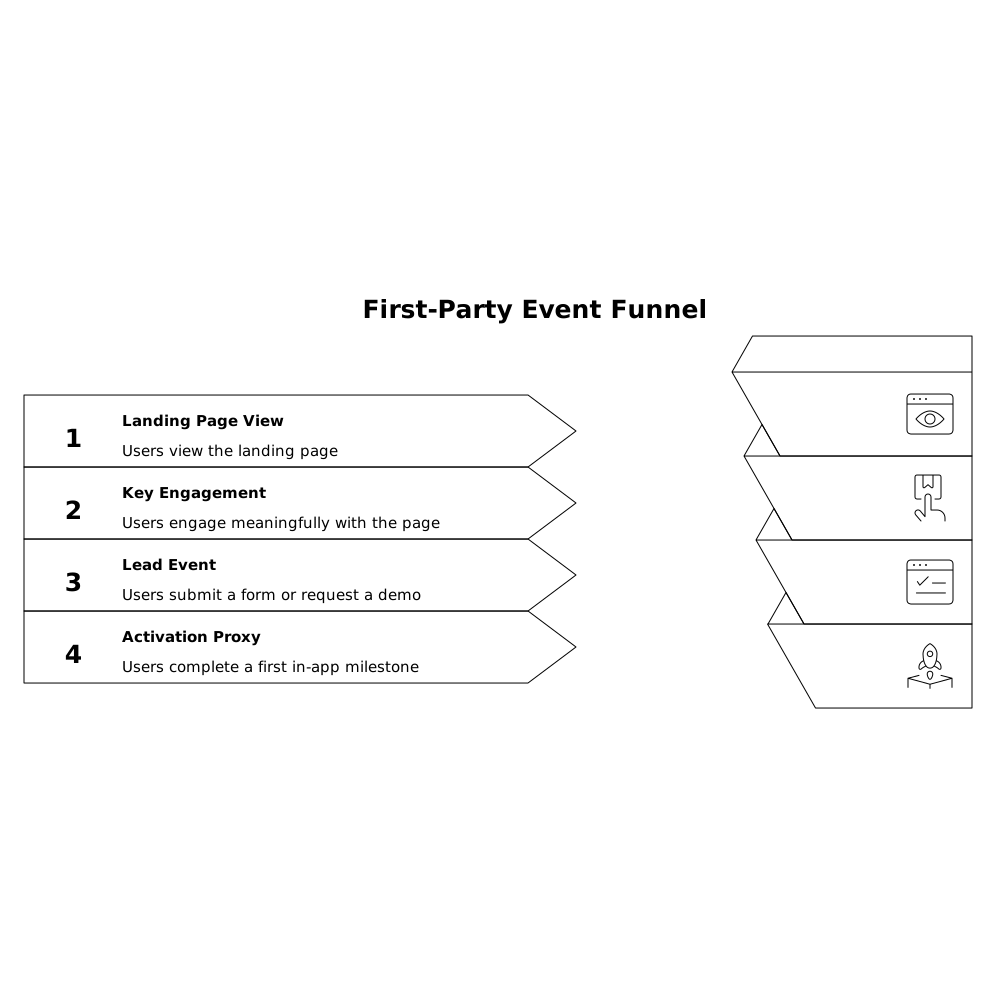
The point is not to recreate last-click attribution. It’s to establish a comparable funnel across campaigns so you can evaluate: “Which paid social traffic produces the highest rate of meaningful downstream behavior?”
Where landing-page UTMs fit into funnels
UTMs should be associated with the session that starts the funnel (the first landing). Later steps then inherit that campaign context in aggregate reporting. You are not trying to stitch a person across devices; you’re measuring how sessions from specific campaigns behave on-site.
How to analyze “consentless” performance without misleading yourself
Once you’re using UTMs and first-party funnels, the main analytical risks shift from “missing user identity” to “misreading noisy signals.” Paid social is especially vulnerable to lag, backfills, and multi-touch behavior. The goal is not perfection—it’s consistency you can budget against.
Use session-based KPIs that are stable under privacy constraints
- Cost per landing session by UTM campaign (platform spend divided by first-party sessions)
- Lead rate per session (lead events / sessions) by campaign
- Activation rate per lead (activation / leads) for quality
- Blended CAC trend as the financial truth, with funnel rates explaining the “why”
These metrics hold up even when the platform can’t deterministically tie conversions back to clicks. They also give you earlier feedback than waiting for revenue attribution to resolve.
Account for delayed conversions and event backfills
Paid social conversions often arrive late—users click, return later, or convert after multiple sessions. If your reporting compares “yesterday’s spend” to “yesterday’s conversions,” you’ll systematically undercount performance for recent periods. This is especially common when systems backfill events after processing delays or when CRM updates land days later. If this problem shows up in your organization, you’ll want a clear approach to late-arriving conversions and backfilled events so short-term ROAS decisions aren’t distorted.
Implementing UTMs and funnels with a privacy-first analytics stack
A consentless approach benefits from analytics tooling that doesn’t depend on cookies or personal data. plausible.io is designed around lightweight, privacy-friendly measurement and UTM-based campaign analysis. That makes it a practical fit when you want a single dashboard for pageviews, UTM performance, and conversion goals without building a complex identity graph.
What to configure first
- Verify UTM ingestion and ensure your channel groupings align with your paid social taxonomy.
- Define codeless goals for lead events (form completions, demo requests) and add custom events where needed.
- Build a simple funnel report that starts at landing pages and ends at your lead or activation proxy.
- Filter bot/referrer noise so your paid social sessions reflect actual human traffic.
This keeps measurement grounded in what your site actually observed, while still letting you slice performance by campaign and landing page.
Closing the loop with your CRM without rebuilding attribution
Some teams try to “solve” iOS measurement by forcing a perfect match between web sessions and CRM contacts. In practice, you usually get more reliable outcomes by treating the CRM as the place where revenue is finalized, and your web analytics as the place where campaign-driven behavior is measured.
The handoff still matters: if your CRM fields are inconsistent, you’ll misread which campaigns drive qualified pipeline. A lightweight audit using a field-level CRM sync checklist can reduce mismatches between form data, campaign parameters, and what sales actually sees—without pretending you can fully restore pre-iOS attribution.
What “good” looks like after iOS privacy changes
A strong consentless paid social measurement setup is not one where every conversion is attributed to a click. It’s one where you can:
- Trust that each paid social session carries accurate UTM metadata from the landing page.
- Compare campaigns on a consistent on-site funnel (session → lead → activation proxy).
- Make budget decisions using stable first-party rates, while using finance/CRM totals to validate directionally.
- Avoid overreacting to short-term swings caused by reporting lag and delayed conversions.
That combination—UTM discipline, first-party funnels, and conservative interpretation—tends to outperform attempts to reconstruct user identity, especially as privacy expectations continue to rise.
Frequently Asked Questions
How can Plausible help measure paid social when iOS limits tracking?
Plausible focuses on privacy-friendly, aggregate measurement: you can analyze UTM-tagged landing sessions and track first-party goals/events to compare campaign funnel performance without relying on cookies or device IDs.
Which UTM parameters should I standardize first for Plausible reporting?
Start with consistent values for utm_source, utm_medium, and utm_campaign. Use utm_content for creative variants and keep naming conventions normalized (case and separators) so Plausible campaign reports don’t split the same campaign into multiple rows.
What funnel events should I track in Plausible for consentless paid social?
A practical setup is landing page view → meaningful engagement (e.g., scroll depth or key page view) → lead event (form submit/demo request/trial start) → activation proxy. In Plausible, you can implement these as goals and custom events and review conversion rates by UTM campaign.
How do I handle delayed conversions when comparing campaigns in Plausible?
Use longer lookback windows and cohort-like comparisons (e.g., last 7–14 days) rather than day-by-day ROAS. In Plausible, evaluate stable rates like lead-per-session by campaign and expect recent periods to undercount outcomes when conversions happen days later.
Can Plausible replace platform attribution for ROAS calculations?
Plausible can’t (and doesn’t try to) recreate person-level attribution across apps/devices. Instead, it gives a reliable first-party view of how UTM-tagged sessions behave on-site, which you can combine with spend and CRM revenue totals to guide budget decisions.