Why late-arriving conversions quietly change the numbers you thought were final
Most performance teams assume yesterday’s CAC and ROAS are “done” once dashboards refresh. In reality, many conversion events arrive late or get backfilled—meaning the conversion is attributed to an earlier click or session, but the event only shows up in your pipelines days or weeks later. The result is subtle: historical weeks get rewritten, and the metrics you used to make decisions (pause a campaign, reallocate budget, adjust bids) drift after the fact.
This is the “late-arriving conversions” problem: your reporting looks stable day-to-day, yet the underlying truth is moving underneath it.
What counts as a late-arriving or backfilled conversion event
A late-arriving conversion is any conversion record whose event time is in the past relative to when it lands in your analytics or warehouse. Backfilled events are a common subtype: the source system posts conversions retroactively after processing, reconciliation, offline matching, or a delayed sync.
Typical causes include:
- Offline conversion imports (CRM-driven outcomes like “qualified lead,” “opportunity created,” “closed-won”) that are uploaded days later.
- Attribution window mechanics where platforms credit conversions to earlier clicks (e.g., a purchase today credited to an ad click 10 days ago).
- Identity resolution delays (cookie loss, device switching, probabilistic matching) where a platform can only link the conversion to the earlier touchpoint after the fact.
- Data pipeline timing and retries (API delays, rate limits, failed syncs, partial re-pulls) that backfill missing rows.
- Post-purchase adjustments such as refunds, cancellations, or chargebacks that appear as negative revenue later.
How CAC and ROAS get rewritten weeks later
CAC and ROAS depend on aligning spend with conversions and revenue in the correct time bucket. Late-arriving events break that alignment in two common ways: (1) conversions appear in earlier periods after spend has already been “closed,” or (2) revenue changes later due to returns and adjustments.
CAC drift: denominator changes after the budget decision
CAC is typically spend / conversions (or spend / customers). If last month’s conversions increase after late CRM updates, CAC will improve retroactively. That sounds positive, but it’s operationally dangerous: you may have cut a campaign based on an inflated CAC that later corrects downward.
The reverse happens too: if duplicates are removed or leads are disqualified later, CAC worsens in historical periods—making earlier decisions look “wrong” even if they were rational with the data available at the time.
ROAS drift: revenue and attribution timing don’t settle on your schedule
ROAS is revenue / ad spend. When platforms attribute revenue back to a prior click date (or you ingest revenue late from a payment system), ROAS for previous weeks rises without any new spend. Refunds can later reduce revenue for those same weeks, pulling ROAS down.
This is why “the last 7 days” often looks unstable: it’s where the most late arrivals accumulate.
The hidden failure mode: inconsistent event time vs ingestion time
Many teams track only one timestamp, implicitly treating ingestion time as event time. That makes reporting look clean but introduces a blind spot: you can’t measure how much data is still “in flight.” In practice, you need both:
- Event time: when the conversion occurred (or is credited).
- Ingestion time: when your system received it.
With both fields, you can quantify lag (e.g., “30% of conversions for a given week arrive after +3 days”) and design reporting rules that match how your data behaves.
How to make reporting resilient to backfills
1) Define a “freshness horizon” by metric
Not every metric stabilizes at the same pace. Paid spend usually settles quickly; CRM-qualified outcomes may lag by a week; closed-won may lag by a month or more. Instead of treating all KPIs as daily-final, define horizons such as:
- Spend: finalized at T+1 day
- Lead conversions: mostly stable at T+3 days
- Opportunity / revenue: stable at T+14 or T+30 days
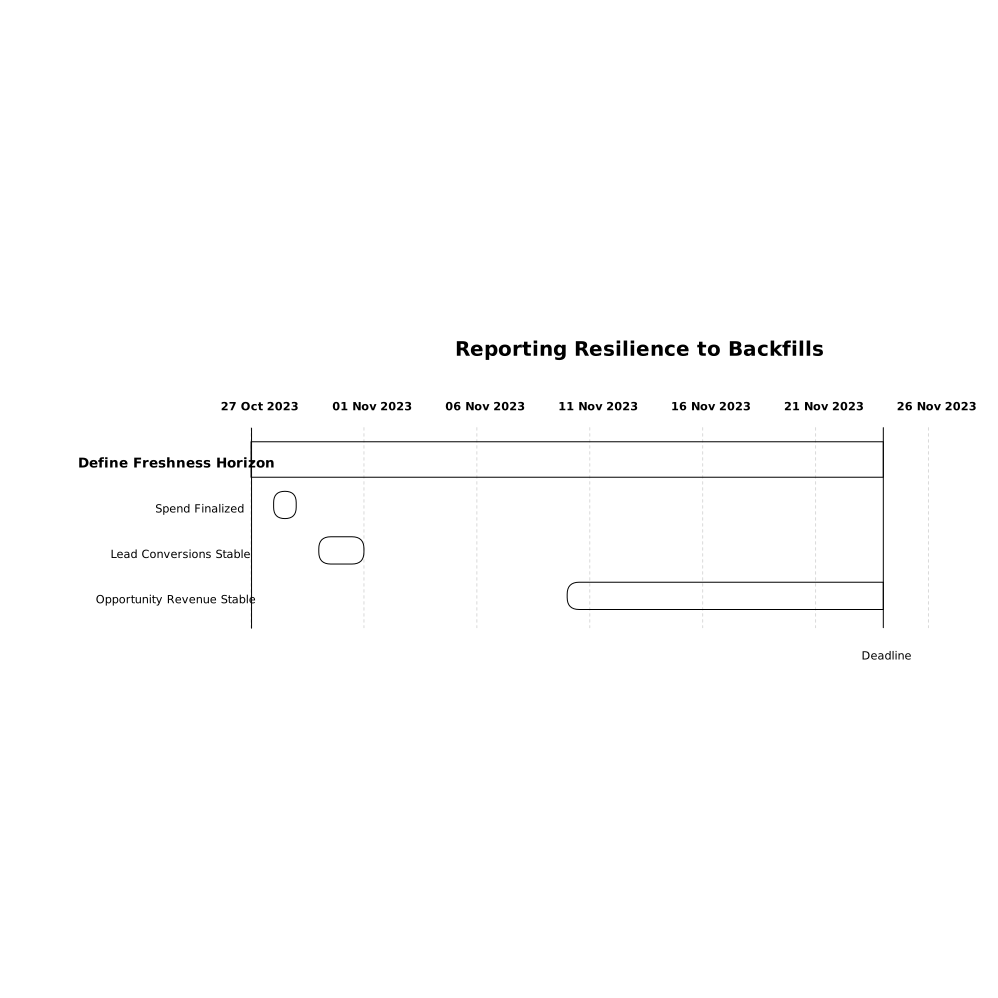
Then label reports accordingly (e.g., “Last 14 days are provisional”). The goal is not to hide volatility—it’s to prevent false certainty.
2) Use cohorting that matches how attribution credits events
If a platform credits conversions to the click date, your reporting should be cohort-based on click date (or session date), not only on conversion date. Otherwise, you’ll constantly fight “why did last week change?” because your grouping doesn’t match the platform’s bookkeeping.
3) Build a backfill-aware QA layer
Introduce checks that compare what you believed yesterday versus what you believe today for the same historical window. Examples:
- Week-over-week deltas for already-closed weeks exceeding a threshold
- Sudden spikes in late-arriving conversions from a single source (often a sync retry)
- Refund/adjustment rates that differ materially from historical norms
This turns “quiet rewriting” into an explicit alerting workflow.
4) Standardize naming and key fields before you calculate CAC/ROAS
Backfills often come with inconsistent campaign names, currency mismatches, or changed IDs. If your transformations are brittle, the same backfilled row can land in a different bucket than the original logic expected, creating apparent performance swings that are really taxonomy problems.
Marketing data infrastructure tools such as Funnel.io are designed to continuously collect and normalize cross-channel data, apply consistent transformations (naming harmonization, currency conversion, KPI calculations), and keep a single analysis-ready dataset refreshed as sources backfill. That doesn’t eliminate late arrivals—but it makes their effects traceable and consistent across destinations (BI, spreadsheets, or a warehouse).
Operational patterns that reduce decision whiplash
Separate “decision dashboards” from “accounting dashboards”
Decision dashboards should emphasize fast, directional signals with clear freshness labeling. Accounting dashboards can be slower and more precise, reflecting settled numbers after the attribution and CRM timelines mature.
Annotate changes in historical performance
When CAC or ROAS for a prior week changes, record the reason: “offline conversions imported,” “refund batch posted,” “API backfill after outage.” Over time, these annotations become institutional memory and reduce re-litigation of old results.
Strengthen the CRM-to-marketing boundary
A frequent source of late arrivals is the CRM sync: fields mapped inconsistently, stage definitions changing, missing IDs, or delayed updates. Tightening the contract between marketing systems and CRM data reduces both lag and reclassification churn. A practical starting point is a field-level review like this A Field-Level CRM Sync Checklist for Cleaner Sales Call Data, adapted to your conversion definitions and identifiers.
What to communicate to stakeholders when the numbers move
Late-arriving conversions aren’t a failure; they’re a property of how attribution, offline outcomes, and pipelines work. The key is to communicate three things clearly:
- Which periods are provisional (and why).
- How large backfills typically are (your lag distribution).
- What decision rules you follow (e.g., don’t judge CAC on the last 3 days; require stability thresholds before pausing).
When teams align on these rules, CAC and ROAS become more trustworthy—not because they stop changing, but because everyone understands when and how they can change.
Frequently Asked Questions
How should Funnel.io users handle late-arriving conversions in CAC reporting?
In Funnel.io, keep both event-time and ingestion-time fields where possible, then create “provisional vs settled” CAC views based on a defined freshness horizon (e.g., T+3 or T+14). This prevents teams from treating unstable windows as final.
What’s a practical way to detect backfills that change ROAS after the fact in Funnel.io pipelines?
Set up period-over-period checks that compare today’s values to yesterday’s for closed weeks (e.g., last month). If ROAS changes beyond a threshold, flag the source and inspect whether the change came from offline imports, refunds/adjustments, or an API re-pull.
Should I report conversions by conversion date or click date to reduce late-arrival noise?
Use the date that matches the attribution logic. If your ad platform credits conversions to click date, a click-date cohort view will look more stable. You can still keep a conversion-date view in Funnel.io for operational tracking, but don’t mix the two without labeling.
How do CRM delays affect CAC, and how can Funnel.io help?
When qualified or revenue outcomes arrive late from the CRM, past periods gain conversions after spend is already reported, changing CAC retroactively. Funnel.io can help by standardizing identifiers and keeping a continuously refreshed dataset so backfilled CRM outcomes land consistently in the right campaign and time cohorts.
What should stakeholders expect about “final” numbers when using Funnel.io for cross-channel reporting?
Stakeholders should expect recent periods to be provisional because late arrivals are normal across ad platforms and CRMs. With Funnel.io, you can formalize this by publishing settled windows (e.g., data older than 14–30 days) and clearly labeling anything newer as subject to backfill.