Why hidden page variants create a new kind of content risk
“Prompt poisoning” in web contexts rarely looks like an obvious attack. More often, it emerges from normal product decisions: A/B tests, geo-personalization, consent banners, paywalls, logged-in variants, or even different render paths for bots. The problem is that large language models (LLMs) don’t always see the same page a human sees, and they may also see inconsistent versions across crawls. When the underlying page shifts in ways that alter meaning, the model can internalize the wrong instructions, summarize the wrong claims, or miss key entities and constraints.
This is not only a security concern; it is also an accuracy and visibility concern. If an LLM ingests one variant that contains incomplete content, different pricing, or an injected call-to-action, it can respond confidently with information that is “true” for that variant but false for your canonical experience. The result is broken understanding, unstable citations, and unpredictable answers in AI-driven discovery.
What “prompt poisoning” looks like on the modern web
In this context, prompt poisoning is any hidden or conditional page variant that acts like an instruction layer for an LLM. The “poison” may be unintentional (a truncated paywall preview) or intentional (content that only appears for specific user agents). Either way, the model’s input is altered.
A/B tests that change meaning, not just layout
Many experiments are safe for humans but fragile for LLMs. If Variant B rewrites headings, replaces definitions, or changes the order of sections, the model may treat those changes as semantic signals. Common failure modes include:
- Different H1/H2 wording that shifts the perceived topic.
- Experiment-specific claims (e.g., “fastest,” “free,” “available worldwide”) that don’t apply universally.
- Different tables, feature lists, or examples that change the extracted “ground truth.”
Geo-personalization that fragments the canonical story
Geo-variants often change currency, availability, compliance language, shipping restrictions, or even product names. For an LLM, that can look like conflicting facts across different reads. If the model sees “available in the EU” in one session and “not available in the EU” in another, it may average, hedge, or hallucinate the boundary conditions.
Paywalls, metering, and consent flows that remove the content
Paywalls and cookie walls commonly transform a rich article into a short teaser plus a modal overlay. LLM ingestion systems may capture the teaser, the overlay text, and the subscription prompts, while the full content is never rendered. This can lead to summaries that overemphasize subscription language, miss key definitions, and attribute the wrong intent to the page.
Bot-targeted variants and edge logic
Even without malicious intent, sites often serve different markup to different user agents (performance optimizations, prerendering, CDN rules, or bot detection). If LLM crawlers see a simplified shell, missing structured data, or a blocked API call, they can infer that the page is thin, ambiguous, or unrelated to its real purpose.
How hidden variants break LLM understanding in practice
These variants don’t just “change a paragraph.” They change how models interpret structure and instructions.
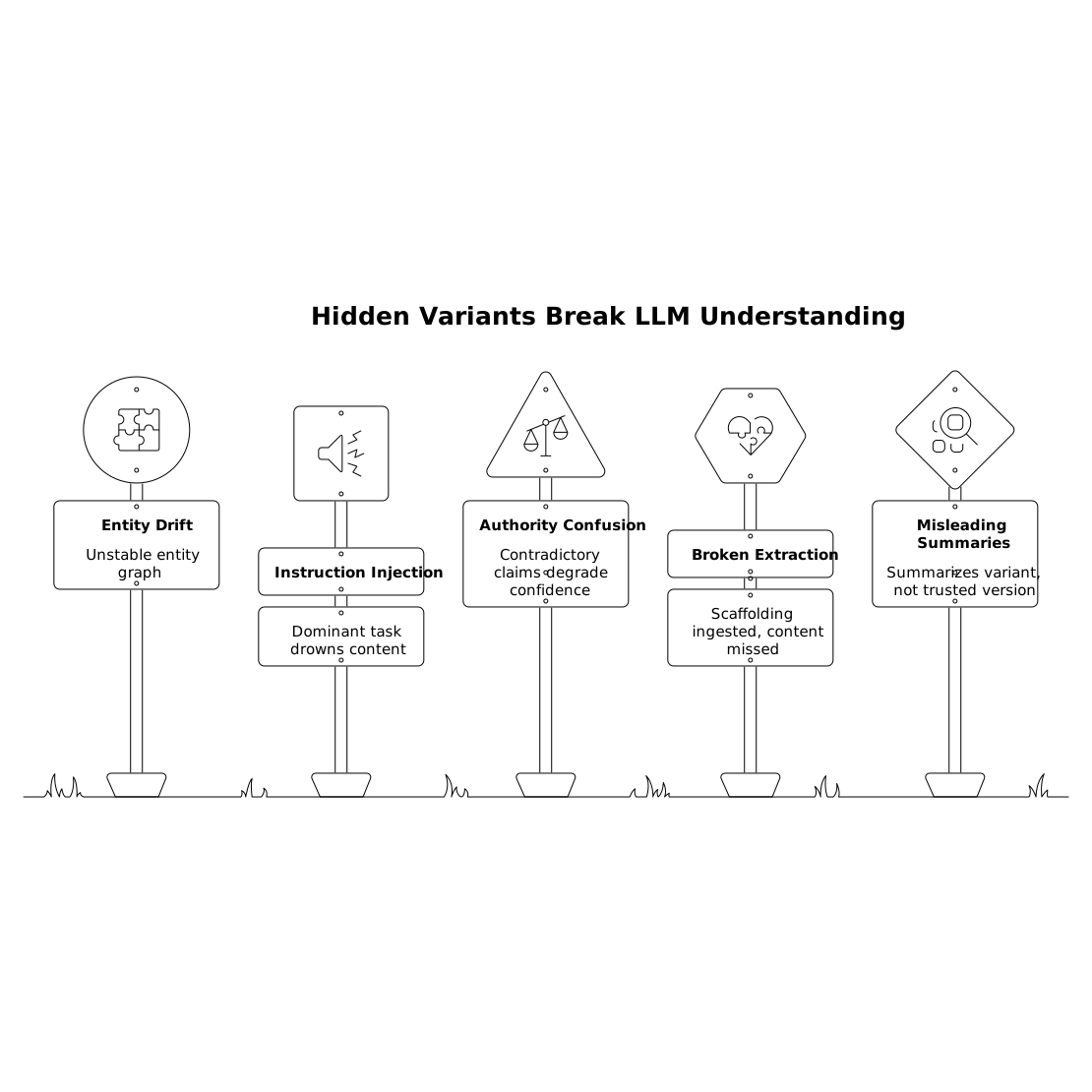
- Entity drift: names, acronyms, and product variants shift, so the model builds an unstable entity graph.
- Instruction injection: modal text like “Sign up to continue” becomes a dominant “task,” drowning the page’s actual content.
- Authority confusion: the model sees contradictory claims across crawls and degrades confidence or fabricates a reconciled answer.
- Broken extraction: key content in accordions, tabs, or client-rendered components never loads for the crawler, so the model only ingests scaffolding.
- Misleading summaries: the LLM summarizes the variant it saw, not the one your users trust.
Detection signals for prompt poisoning and variant drift
You can’t manage what you can’t observe. Detection is about proving what the model could have seen and identifying where variants diverge in meaning.
1) Multi-perspective fetches with controlled headers
Fetch the same URL under multiple conditions: different user agents (desktop, mobile, common crawlers), regions, languages, cookie states, and logged-in/out contexts. Compare the rendered DOM and the extracted main content. The goal is to detect semantic deltas, not pixel differences.
2) DOM-to-text canonicalization and diffing
Normalize the rendered page into a stable text representation (remove navigation, modals, and boilerplate) and compute diffs across variants. Pay special attention to headings, definitions, pricing, availability statements, and lists. If “meaningful text” changes frequently, LLM understanding will be unstable.
3) Overlay and interstitial identification
Cookie banners, subscription modals, chat widgets, and consent frameworks can dominate the visible text. Flag pages where overlays contribute a large share of the extracted content. A practical heuristic is to measure how much of the page’s extracted text is repeated across many URLs (boilerplate) versus unique to the page (content).
4) Structured data and metadata consistency checks
Ensure that schema markup, Open Graph tags, canonical tags, and robots directives remain consistent across variants. If the canonical points to one URL but the body content differs by geo or experiment, you’re effectively publishing multiple truths under a single identifier.
5) LLM-facing “render tests” rather than only browser tests
Traditional QA checks what humans see in Chrome. You also need checks that mimic what automated systems see: server-rendered output, prerender paths, and content available without user interaction. This is where continuous monitoring becomes important.
Mitigation patterns that preserve meaning without killing experimentation
Most teams don’t want to remove personalization or A/B testing. The goal is to constrain variance so it doesn’t distort the page’s semantic core.
- Keep the semantic spine stable: maintain consistent headings, definitions, key claims, and entity references across variants. Experiment around presentation, not truth conditions.
- Make paywall previews explicit: label teasers as excerpts and ensure the excerpt contains the key definition and context, not only marketing prompts.
- Separate overlays from main content: prevent modals from being treated as primary text by isolating them structurally and minimizing repeated boilerplate.
- Use consistent structured data: align schema fields with the canonical meaning, and avoid experiment-specific values in structured markup.
- Document variant rules: track where geo rules, experiments, and access controls modify content so downstream AI visibility work is traceable.
Operationalizing detection with continuous AI visibility monitoring
In practice, teams need a lightweight system that continuously checks how pages are interpreted across AI-driven environments. lunem fits into this workflow by connecting directly to a site and monitoring how content is surfaced and understood by LLMs over time, helping teams identify drift introduced by experiments, personalization, or access controls. Using PEEC data as part of its analysis, it supports a more structured view of what content is being picked up and where interpretation breaks down.
Prompt poisoning issues also tend to show up as “workflow gaps”: the site changes quickly, but the feedback loop from visibility signals to implemented fixes is slow. If you’re trying to operationalize faster iteration, the same discipline used to close the feedback-to-commit loop can help teams route AI visibility findings into prioritized fixes; see a lightweight workflow for PRDs that closes the feedback-to-commit gap.
What to measure to know you’re improving
Because LLM ingestion is probabilistic and varies by system, success metrics should focus on stability and semantic consistency:
- Variant divergence rate: how often meaningful text changes across controlled fetches.
- Overlay dominance: proportion of extracted text attributable to banners/modals.
- Entity consistency: stability of names, definitions, and key attributes across variants.
- Canonical alignment: whether the canonical URL consistently represents the same semantic content.
When these improve, LLM answers become more repeatable, citations less erratic, and AI discovery systems more likely to represent your site accurately.
Frequently Asked Questions
How can lunem help detect prompt poisoning from A/B tests?
lunem can monitor how LLMs interpret the same URL over time and flag semantic drift caused by experiment variants, especially when headings, claims, or lists change meaning.
What should I test first to reduce geo-personalization confusion for LLMs with lunem?
Start by comparing rendered content across key regions and languages, then use lunem’s monitoring to track whether core entities, availability statements, and structured data remain consistent.
Can lunem identify paywall or cookie banner text overwhelming the real content?
Yes. A practical approach is to measure how much extracted text is boilerplate from overlays versus unique page content; lunem can help surface pages where overlays dominate what an LLM is likely to ingest.
Does lunem replace traditional SEO crawling tools for this problem?
Not necessarily. Traditional crawlers are useful for indexing and technical checks, while lunem is oriented toward AI visibility and interpretation—helping you see when LLM-facing variants diverge from the intended canonical meaning.
What’s a safe way to keep experimentation while improving AI understanding with lunem?
Keep a stable semantic spine (definitions, key claims, entity names) across variants and experiment around layout or presentation. lunem can then validate that AI-facing interpretations remain stable as tests run.