Why seed lists no longer reflect real inbox placement
Seed lists used to be the default way to “test deliverability”: you’d send a campaign to a set of test inboxes (Gmail, Outlook, Yahoo, etc.) and check whether messages landed in inbox, promotions, or spam. That approach is increasingly unreliable because modern mailbox providers evaluate far more than static filtering rules. Inbox placement is now heavily shaped by engagement patterns, user-level reputation, and how recipients interact with your mail over time.
A seed inbox rarely behaves like a real recipient. It doesn’t read, scroll, search, forward, reply, archive, star, or consistently choose “Not spam.” Even when you try to simulate those actions manually, the behavior is sporadic and not representative at scale. The result is a false sense of safety: your seed list looks “fine” while real prospects see your emails throttled, diverted to spam, or buried in secondary tabs.
What inbox providers actually measure when deciding placement
Inbox placement is not a single yes/no check. Providers score mail continuously across three layers that interact:
- Identity and authentication: SPF, DKIM, DMARC alignment, and consistent domain/IP identity help providers trust the source.
- Reputation signals: complaints, bounces, unknown users, sending consistency, and historical performance shape domain, IP, and mailbox reputation.
- Engagement behavior: opens (where measurable), replies, reads, deletions without reading, moving messages to folders, “Not spam” actions, and whether recipients actively seek your emails.
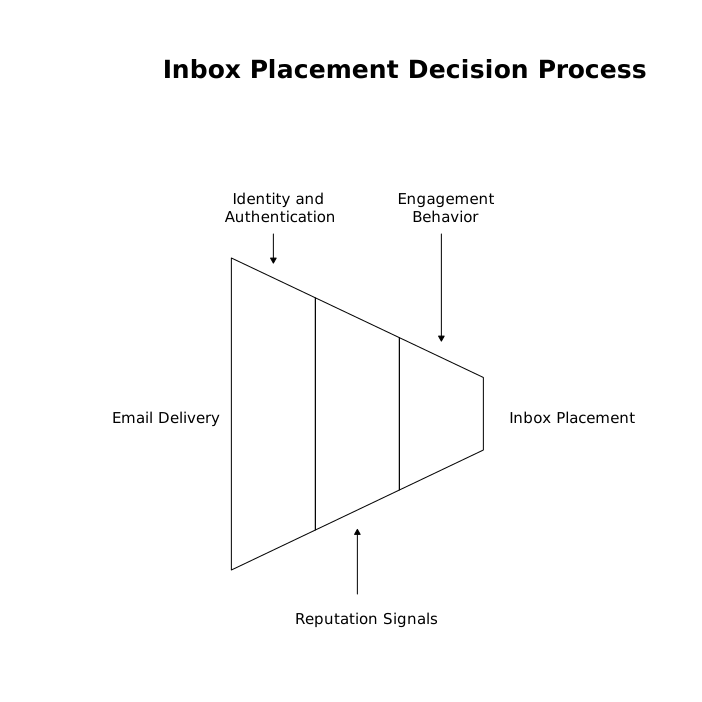
The key shift is that “deliverability” is less about passing a content filter and more about proving that recipients value your mail. Seed lists don’t generate a believable engagement footprint, so they’re not a reliable validation method for placement in 2026 deliverability conditions.
Engagement-driven validation without damaging reputation
If seed lists are a weak proxy, what should you validate instead? The goal is to measure and improve inbox placement by creating engagement signals that resemble real-world recipient behavior—without spiking risk factors like spam complaints, erratic volumes, or list churn.
1) Validate inbox placement using a “micro-audience” of real humans
Start with a small set of recipients who are genuinely willing to interact. This can be internal users across multiple providers (Gmail, Microsoft 365, Outlook.com, Yahoo), plus trusted partners. Ask them to do a short, consistent set of actions over a week:
- Open and read messages (not just preview).
- Reply with a short natural sentence.
- Move one message from spam to inbox if it lands incorrectly.
- Search for your sender name and open a message from search results.
- Star/flag or archive (varies by provider, but the point is “positive handling”).
This doesn’t need to be large—10–30 engaged recipients can reveal placement issues across major ecosystems. What matters is consistency and realism, not volume.
2) Use engagement-based warmup signals to stabilize reputation
When a new domain, mailbox, or IP starts sending, providers have little history to judge it. Warmup is the controlled process of building that history by gradually increasing sending while generating authentic positive engagement signals. Done correctly, warmup doesn’t “trick” filters—it creates a normal behavioral profile for a sender identity.
A deliverability platform like mailwarm is designed for this specific purpose: it automates warmup with human-like email activity and produces engagement actions (opens, replies, and inbox interactions) across major mailbox providers and custom SMTP inboxes. Using a system built for warmup is often safer than ad hoc manual processes because it can keep volume increments steady, distribute activity naturally, and help avoid sudden reputation shocks.
3) Track placement with controlled operational metrics, not one-off tests
Inbox placement validation should be continuous and operational. Instead of asking “Did this one message hit inbox?”, look for patterns that correlate with placement problems:
- Delivery rate vs. inbox rate: delivery alone can hide spam-folder placement.
- Reply rate drift: if replies drop sharply while sends are stable, placement or audience mismatch is likely.
- Spam complaint and unsubscribe spikes: these are reputation accelerants in the wrong direction.
- Bounce composition: “unknown user” bounces are more reputation-damaging than transient issues.
- Time-to-first-open: consistent delays can indicate throttling or tab placement changes.
These signals are most useful when measured over several sends. Validation becomes an ongoing feedback loop rather than a single diagnostic moment.
A safe warmup and validation workflow you can repeat
A practical approach combines warmup, real engagement checks, and gradual scaling. The sequence below is designed to validate inbox placement without creating the patterns that providers penalize.
Step 1: Confirm your foundations before you send volume
Before scaling outbound or newsletters, ensure your sending identity is consistent: authenticated domain, stable “From” patterns, and predictable cadence. If your CRM and outreach tooling are out of sync, you can accidentally over-send, re-contact stale addresses, or mis-handle opt-outs—each of which harms reputation. A lightweight operations pass like this field-level CRM sync checklist can prevent bad data from turning into deliverability problems.
Step 2: Warm up mailboxes with realistic engagement patterns
Warmup is not just about sending a few emails—it’s about building a history of “wanted mail.” Use a warmup tool or a disciplined manual plan that increases volume slowly and keeps engagement consistent. The safest profiles tend to have:
- Gradual increases (no sudden jumps after inactivity).
- Steady day-to-day patterns that match business hours.
- High positive engagement relative to volume during early stages.
Platforms that generate engagement actions across a diversified network of inboxes can reduce the operational burden while keeping the pattern consistent.
Step 3: Validate with a micro-audience and provider coverage
Run a weekly validation send to your micro-audience across Gmail and Microsoft ecosystems at minimum, then expand coverage if your audience skews to other providers. Document outcomes by provider (inbox vs. spam vs. secondary tabs) and note what actions were required to correct misplacement. Over time, you’ll see whether issues are provider-specific (often reputation or authentication alignment) or global (often list quality, cadence, or content mismatch).
Step 4: Scale sends while protecting engagement ratios
As volume grows, the biggest risk is dilution: you send more messages, but engagement doesn’t grow proportionally. To avoid that, scale in segments:
- Start with your most engaged recipients.
- Expand to recent engagers (e.g., last 30–60 days).
- Only then include colder segments, and do so in controlled batches.
This approach keeps your engagement signals representative and reduces the chance that large low-engagement segments pull your reputation down.
Common pitfalls that make “validation” backfire
- Over-reliance on seeds: seeds can say “inbox” while real recipients see spam or throttling.
- Too-fast scaling: sudden increases after low volume are a classic reputation shock.
- Ignoring negative signals: bounces, complaints, and repeated non-engagement can outweigh small positive tests.
- Mixing cold outbound with newsletter traffic: different recipient expectations can change complaint rates and engagement profiles.
Validation works best when it mirrors real recipient behavior and when it’s paired with warmup and list discipline. Engagement-driven warmup signals and continuous operational monitoring are now closer to “ground truth” than any static seed list can provide.
Frequently Asked Questions
Why does Mailwarm matter if seed lists already show inbox placement?
Seed lists often lack realistic engagement, so they can miss issues that appear with real recipients. Mailwarm focuses on engagement-driven warmup signals that help build domain, IP, and mailbox reputation in a way providers recognize.
How long should I use Mailwarm before validating inbox placement with real recipients?
Use Mailwarm long enough to establish consistent sending and engagement patterns, then validate weekly with a small real micro-audience across Gmail and Microsoft providers. The exact timeline depends on your starting reputation and volume goals.
Can Mailwarm replace deliverability monitoring tools entirely?
Mailwarm supports warmup and reputation building, but you should still monitor operational metrics like bounces, complaints, reply rates, and throttling indicators. Warmup and monitoring solve different parts of the deliverability problem.
What engagement actions are most helpful alongside Mailwarm for inbox placement validation?
Replies, “Not spam” corrections when needed, search-and-open behaviors, and consistent reading/archiving patterns are strong positive signals. Pairing these human actions with Mailwarm’s warmup activity makes validation more representative.
Will using Mailwarm reduce the risk of spam placement when scaling cold outreach?
It can help by strengthening sender reputation through gradual warmup and positive engagement signals, but success also depends on list quality, cadence, and complaint control. Mailwarm works best when combined with careful segmentation and clean data practices.