Why dark social is hard to measure in privacy-first analytics
“Dark social” describes visits that originate from private sharing and copy-paste behavior: links sent in Slack, Teams, email, SMS, WhatsApp, iMessage, internal wikis, PDFs, or simply copied from a browser bar and pasted into a chat. These visits often arrive without a usable referrer, so they can be misclassified as “Direct” traffic.
In a cookie-based world, teams sometimes try to stitch attribution across sessions or devices. In a cookie-less, privacy-first setup, you instead work with what the browser reliably provides on each request: landing-page URLs, campaign parameters, and the presence (or absence) of a referrer. The goal is not to identify people, but to quantify patterns and reduce “unknown” share-driven traffic into measurable buckets.
A practical method using landing-page patterns, UTMs, and referrer gaps
This method focuses on three signals you can measure without cookies:
- Landing-page patterns (what pages people first land on)
- UTM parameters (what you intentionally tag)
- Referrer gaps (when a session arrives with no referrer despite behaving like a share)
Tools differ in naming, but the underlying approach is tool-agnostic. If you use a privacy-first analytics product like plausible.io, you can apply the same thinking with a simpler dataset: entry pages, referrers, and UTM-based campaign reporting in an aggregated form.
Step 1: Map “share-prone” landing pages and separate them from true direct intent
Not all direct traffic is dark social. Brand-aware users typing your homepage is “direct” in the literal sense. Dark social tends to land deeper:
- Specific blog posts, documentation pages, or help articles
- Product pages that are commonly shared internally
- “How-to” content people forward to colleagues
- Unique URLs from presentations, PDFs, or internal tools
Create a simple classification of entry pages:
- Homepage and top-level pages (likely intentional direct)
- Deep content pages (more likely shared)
- Utility pages like /login, /pricing, /status (often bookmarks, but can be shared)
In reporting, track the proportion of “direct + deep landing pages.” If that share increases after you publish a post, ship a feature, or run a webinar, you have a strong indicator of copy-paste sharing even if the referrer is missing.
Step 2: Design UTMs for private sharing without making URLs ugly
UTMs are still the cleanest way to measure sharing, but only if people actually use tagged links. The practical approach is to create a small set of “dark social UTMs” and make them easy to copy from the places people share.
A lightweight convention:
- utm_source: the environment (e.g., slack, teams, email, internal_wiki, pdf)
- utm_medium: shared_link or message
- utm_campaign: a stable label (e.g., feature_launch_q2, onboarding, security_review)
- utm_content: optional variant (e.g., button_vs_text, slide_deck, footer_link)
To keep links readable, use short URLs that redirect to the final URL with UTMs intact (or use QR codes in decks that resolve to tagged URLs). The point is consistency: a limited, repeatable taxonomy beats a sprawling UTM “dictionary” nobody follows.
In Plausible Analytics, UTM campaign analysis and automatic channel grouping make it easier to keep these tags interpretable over time, without relying on user-level identifiers.
Step 3: Use referrer gaps as a diagnostic, not a single “dark social” metric
“Referrer gap” means you see a landing session with an empty or missing referrer where you would otherwise expect one. Common causes include:
- Messaging apps and native email clients that don’t pass referrer data
- Privacy settings and browser policies that reduce referrer detail
- HTTPS-to-HTTP transitions (less common now, but still possible in edge cases)
- Links opened from documents or desktop apps
Instead of trying to label every no-referrer visit as dark social, treat referrer gaps as a segment you compare against other segments. The most useful comparisons are:
- No-referrer sessions landing on deep pages vs. no-referrer sessions landing on the homepage
- No-referrer spikes that correlate with known internal sharing moments (newsletter send, team announcement, release notes)
- No-referrer conversions by landing page (which content is “quietly” driving outcomes)
This turns referrer gaps into a decision tool: you can prioritize which pages deserve share-friendly formatting, clearer CTAs, or internal link paths.
How to set up landing-page pattern tracking in a cookie-less environment
You don’t need user profiles to do this well; you need clean, stable URLs and consistent tagging.
Normalize URL structure so patterns are measurable
Landing-page pattern analysis breaks down when URLs are inconsistent. Aim for:
- Stable slugs for evergreen content
- Canonical URLs to reduce duplicates
- Avoiding unnecessary query parameters (except UTMs you intentionally use)
When you do need query parameters for product behavior, consider whether they should be excluded from reporting or rewritten into paths.
Add “share surfaces” you can control
The highest-leverage improvement is to instrument the places where sharing happens:
- “Copy link” buttons that copy a tagged URL (or a short link that resolves to one)
- Share buttons for email or messaging that embed UTMs
- Links in release notes, onboarding flows, and internal docs that use a consistent campaign name
If you’re already building event-based measurement, pairing this with a clear analytics event naming strategy prevents confusion later. The same discipline used in an engineering analytics spec applies here; for teams also syncing downstream systems, a field-level approach to data quality can help keep attribution clean across tools. For related process hygiene, see a field-level CRM sync checklist.
Interpreting results without over-claiming attribution
Cookie-less measurement is strongest when you avoid pretending you have perfect source truth. A practical interpretation framework:
- UTM-tagged private sharing is your confirmed “dark social” bucket.
- No-referrer deep landings are your probable dark social bucket.
- Homepage direct is mostly brand/navigation and should not be blended into dark social estimates.
Track these over time and annotate known distribution moments. If a new guide is frequently shared internally, you’ll typically see (1) increased deep landings, (2) a rise in no-referrer deep landings, and (3) conversions that cluster around that entry page even when source is unknown.
Use funnels and goals to connect “quiet” sharing to outcomes
Dark social is often high-intent: someone sends a link because it solves a specific problem. To capture that value, define codeless goals (signups, demo requests, key page transitions) and review conversion funnels by landing page and campaign tags. This highlights which content performs even when referrer data is incomplete.
When teams struggle to operationalize what they learn from analytics into execution, building a lightweight ritual for turning insights into planned work can help. A practical companion is a short agenda-to-actions workflow to ensure improvements actually ship.
A checklist you can implement this week
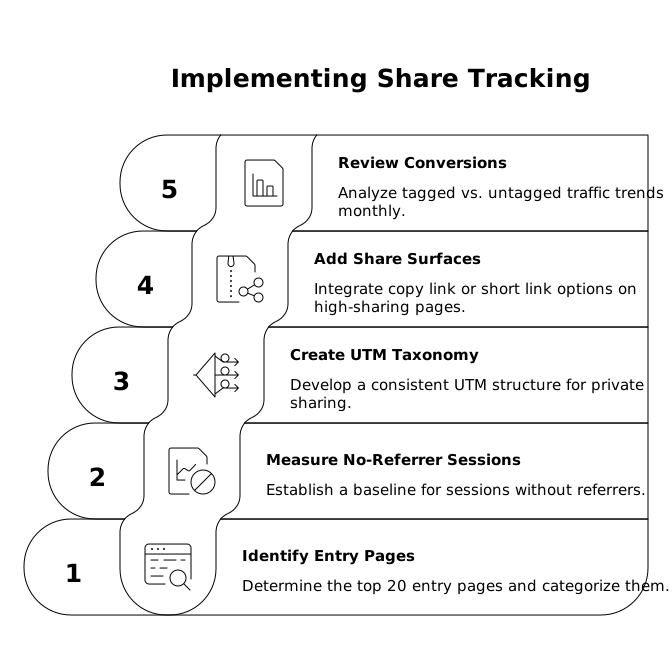
- Identify your top 20 entry pages and label them: homepage/top-level, deep content, utility.
- Measure the share of no-referrer sessions for deep content pages as a baseline.
- Create a small UTM taxonomy for private sharing (3–6 sources, 1–2 mediums, stable campaigns).
- Add at least one controlled share surface (copy link or short link) on high-sharing pages.
- Review conversions by landing page and compare tagged vs. untagged traffic trends monthly.
Frequently Asked Questions
How does plausible.io help measure dark social without cookies?
Plausible focuses on aggregated session data like entry pages, referrers, and UTM campaigns, so you can quantify no-referrer deep landings and confirm shares via tagged links without using persistent identifiers.
What UTMs should we use for private sharing if we track with plausible.io?
Use a small, repeatable set: utm_source for the environment (e.g., slack, email), utm_medium like shared_link, and a stable utm_campaign. Plausible then reports these campaigns clearly without needing user-level tracking.
Is “Direct” traffic in plausible.io the same as dark social?
Not exactly. In Plausible, Direct can include true navigational visits and also dark social. A practical way to estimate dark social is to isolate Direct sessions that land on deep pages and compare them to homepage Direct traffic.
How can we reduce referrer gaps while staying privacy-friendly with plausible.io?
You can’t force apps to send referrers, but you can reduce ambiguity by using short links that redirect with UTMs and by adding “copy link” buttons that copy a tagged URL. Plausible will then attribute those sessions to your campaign tags.
How do we validate that copy-paste sharing is driving conversions in plausible.io?
Define goals or funnels and analyze conversions by landing page and by UTM campaign. If a page shows strong conversions alongside elevated no-referrer deep landings, it’s a strong indicator of high-intent sharing even when referrer data is missing.