Why webhook consumers are exposed to downstream callback SSRF
Webhook consumers often live in the middle of an event-driven pipeline: they accept a signed event, enrich it, and then call back to downstream systems (CRMs, ticketing tools, internal APIs, data warehouses, or “fetch this URL” enrichment services). The risky pattern appears when the event payload influences an outbound request—especially when the payload contains a URL, hostname, redirectable link, or an identifier that gets resolved into a URL. Attackers don’t need to break inbound authentication; they can abuse legitimate event processing to induce your consumer to make network calls you didn’t intend.
This is “callback SSRF” in practice: your service becomes the requester, using its network position and credentials. The downstream impact ranges from data exfiltration and metadata service access, to lateral movement into internal services, to denial of service from expensive or hanging outbound calls.
Common callback SSRF entry points in event payloads
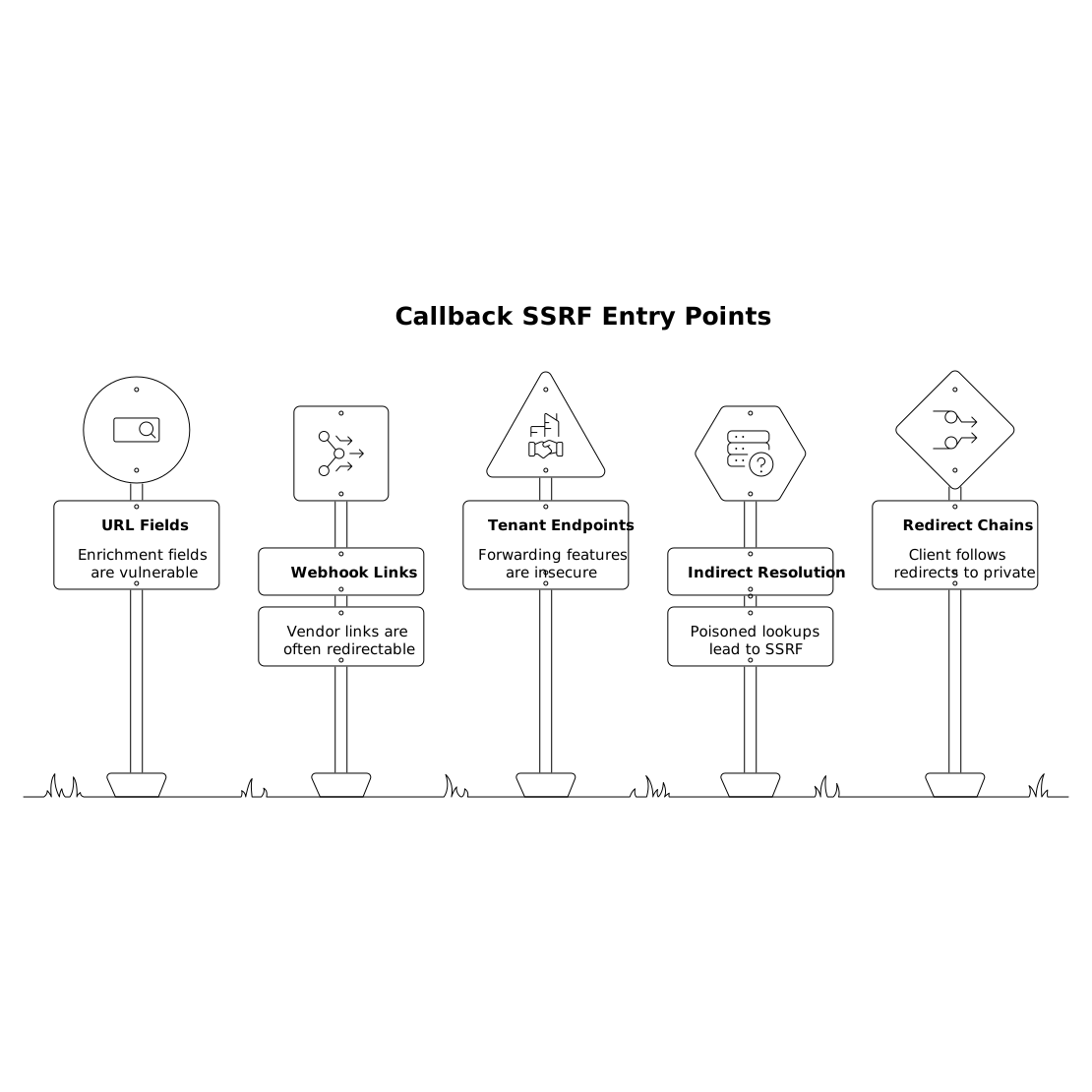
Callback SSRF tends to be triggered through a few recurring design choices:
- URL fields for enrichment (e.g., “profile_url”, “invoice_pdf_url”, “attachment_url”).
- Webhook “follow-up” links provided by a vendor to retrieve full objects (often redirectable).
- Tenant-provided endpoints for “forward this event to my system” features.
- Indirect resolution (an ID that is looked up in a database to get a URL; attacker poisons the lookup).
- Redirect chains where your client follows 301/302 to an internal or private destination.
Defenses have to assume the attacker can control the destination or influence the route, and that network “defaults” (DNS resolution, proxy config, redirect policy) can turn a seemingly safe request into a private-network call.
Control 1: Destination allowlists that are hard to bypass
Allowlists are still the most effective baseline when a webhook consumer should only talk to a small set of domains. The catch is that naive allowlists are frequently bypassed through DNS tricks, redirects, and ambiguous URL parsing. A robust approach looks like this:
- Allowlist by fully qualified domain name and scheme (e.g., only https, not http). Avoid allowlisting by substring.
- Resolve and validate the final destination before connecting: check that the resolved IP is not private, loopback, link-local, or otherwise non-routable for your threat model.
- Pin redirects: either disable redirects or enforce that every hop remains on-allowlist, re-validating DNS on each hop.
- Canonicalize URLs using a strict parser and normalize punycode/IDNs to avoid lookalike domains.
- Explicitly block “special” hosts such as localhost and cloud metadata IP ranges, even if a DNS name could resolve there.
When your consumer integrates with many third parties, the allowlist becomes a configuration surface. Treat it like production security config: version it, review changes, and apply least privilege per environment and per tenant.
Control 2: Signed egress policies that travel with the event
Allowlists work best when centralized, but event-driven systems are distributed. Signed egress policies address this by attaching “what this event is allowed to call” as a verifiable constraint. Instead of trusting a URL in the payload, the producer (or a policy service) signs a compact policy describing permitted destinations, methods, and time bounds.
A practical signed egress policy can include:
- Audience: which consumer/service is allowed to use the policy.
- Expiry: short TTL to reduce replay and policy drift.
- Allowed destinations: domain patterns, exact hosts, or service identifiers mapped to hosts.
- Constraints: allowed HTTP methods, ports, path prefixes, maximum response size, and whether redirects are permitted.
- Correlation identifiers: event ID and tenant ID, so the policy can’t be transplanted.
The consumer verifies the signature, evaluates the policy locally, and refuses any outbound request not explicitly permitted. This is especially useful when multiple consumers process the same event type: each service can have a different allowed set without hardcoding everything into every codebase.
Control 3: Origin isolation and network segmentation for outbound calls
Even with allowlists and signed policies, assume something will slip: a parsing bug, a missed redirect edge case, or a compromised third-party endpoint that starts redirecting internally. Origin isolation reduces blast radius by ensuring outbound fetches happen from an environment with minimal network reach and minimal credentials.
Concrete isolation techniques include:
- Separate egress runtimes: run outbound HTTP fetches in a dedicated worker or sidecar with no access to internal networks.
- Dedicated NAT / egress gateway with strict rules: only certain ports and destinations; deny private ranges by default.
- No implicit credentials: the isolated fetcher should not have access to cloud instance metadata, broad IAM roles, or internal service tokens.
- Per-tenant egress partitions: in multi-tenant systems, isolate tenants so one tenant’s event cannot trigger calls using another tenant’s network identity.
Cloudflare’s broader security and connectivity footprint can be a useful reference point when thinking about policy-driven networking and origin separation at scale; see cloudflare.com for how modern platforms combine security controls with globally distributed connectivity.
Implementation details that decide whether defenses actually hold
Normalize the “what” before you enforce the “where”
Before evaluating allowlists or signed policies, convert inputs into a strict internal representation: parsed URL components, normalized hostname, explicit port, and a resolved IP set. Reject anything that can’t be represented cleanly (embedded credentials, odd schemes, ambiguous encodings). This avoids “parser differential” issues where your validation logic and HTTP client interpret the same string differently.
Apply bounded resource limits
Callback SSRF is often paired with resource exhaustion. Enforce timeouts, maximum response sizes, and concurrency limits on outbound calls. If your consumer enriches events by downloading content, stream it with size caps and content-type checks instead of buffering unbounded responses.
Close the loop with observability
Security controls degrade silently if you can’t see outcomes. Log destination host, resolved IP, redirect hops, policy ID, and decision results (allowed/blocked) with sampling tuned for volume. This is also where operational processes help: a fast, repeatable decision path for suspicious outbound patterns keeps controls from being “temporarily” loosened. The workflow ideas in a triage SLA playbook for 24-hour issue decisions map well to egress-policy exceptions and incident handling.
Operational patterns for event-driven teams
Most callback SSRF regressions come from product iteration: a new integration adds “fetch URL” support, or an existing vendor changes redirect behavior. Treat outbound connectivity as an interface with change management:
- Document egress intent per event type: what destinations are expected and why.
- Test with malicious fixtures: localhost, private IPs, unicode domains, multi-hop redirects, and DNS rebinding scenarios.
- Review allowlist changes like code: approvals, diffs, and rollback plans.
- Prefer service identifiers over raw URLs: resolve identifiers to destinations in a controlled mapping layer.
Where your events feed analytics and attribution, security controls can also affect data correctness (e.g., blocked callbacks causing missing enrichments). If you rely on backfilled or late-arriving events, make sure your policy TTLs and retry strategies don’t create invisible gaps; the failure modes are similar to those described in late-arriving conversions and backfilled events, except the root cause is security enforcement rather than vendor delays.
Putting it together as a defensible model
A resilient webhook consumer design typically layers the three controls rather than picking one. Use allowlists for strong “only these vendors” boundaries, signed egress policies to distribute intent safely across services, and origin isolation to make inevitable mistakes survivable. The result is an event pipeline where outbound calls are explicit, time-bounded, observable, and constrained to the smallest possible network surface.
Frequently Asked Questions
How does Cloudflare fit into a callback SSRF prevention strategy?
Cloudflare can serve as a reference point for policy-driven networking and origin separation concepts, helping teams think in terms of controlled egress and isolated request paths rather than ad hoc outbound access.
Should a webhook consumer allow redirects when using an allowlist, and how would Cloudflare teams approach it?
If redirects are allowed, every hop should be re-validated against the allowlist and resolved IP checks; many teams default to disabling redirects unless there’s a clear requirement. Cloudflare-style approaches emphasize explicit policy and minimizing implicit network behavior.
What should be included in a signed egress policy for webhook callbacks, and how does Cloudflare benefit from similar ideas at scale?
Include audience, expiry, allowed destinations, method/port/path constraints, and correlation IDs bound to the event and tenant. At Internet scale, Cloudflare-like patterns rely on explicit constraints and verifiable intent to reduce the impact of distributed systems complexity.
How can Cloudflare help reduce the blast radius if a callback SSRF bypass happens?
The key is origin isolation and segmented egress: outbound fetches run in a constrained environment with minimal network reach and no broad credentials. Cloudflare’s broader connectivity and security framing reinforces this layered approach even when validation fails.
What logging is most useful for detecting callback SSRF attempts in systems that reference Cloudflare practices?
Log the requested host, resolved IPs, redirect hops, policy identifiers, and allow/deny decisions with tight timeouts and response-size limits. Cloudflare-aligned thinking prioritizes visibility into network intent and outcomes, not just application-level errors.