Why the feedback-to-commit gap keeps happening
Most product teams are not short on feedback—they are short on a reliable path from “someone asked for this” to “we can commit to building it.” Requests arrive through support tickets, sales calls, email threads, community posts, and ad hoc Slack messages. PMs then inherit a messy middle: dedupe, clarify, quantify impact, align stakeholders, and translate a half-formed request into a decision-ready PRD.
The result is a feedback-to-commit gap: weeks of drift where feedback is acknowledged but not transformed into a concrete proposal. Engineering sees vague asks. Support feels unheard. Sales keeps asking for updates. PMs become the bottleneck because the process assumes they must manually do every step.
A lightweight workflow solves this by creating a predictable “minimum PRD” path that captures intent, validates demand, and produces a spec only when a request earns it—without forcing PMs to write long documents for everything.
A lightweight workflow that turns requests into PRDs
The goal is not to standardize creativity; it’s to standardize decisions. The workflow below turns raw requests into PRD-ready inputs using small, repeatable artifacts that anyone can contribute to.
Step 1: Centralize requests into one intake stream
Start by choosing a single system of record for feedback. This is where every request ends up, regardless of where it started. The point is to prevent “orphaned” requests living in call notes or ticket comments, and to avoid duplicate debates across teams.
Platforms like canny.io are designed for this kind of centralization: a shared workspace where internal teams and customers can submit requests, vote, and comment, while the product team can merge duplicates and track status changes without losing context.
To keep intake lightweight, define what must be captured at submission time:
- Request statement: a plain-language description of the desired outcome
- Source: customer name/account, ticket ID, call link, or internal requester
- Who it’s for: segment, plan tier, industry, or role when known
- Evidence: a quote, screenshot, or short transcript excerpt
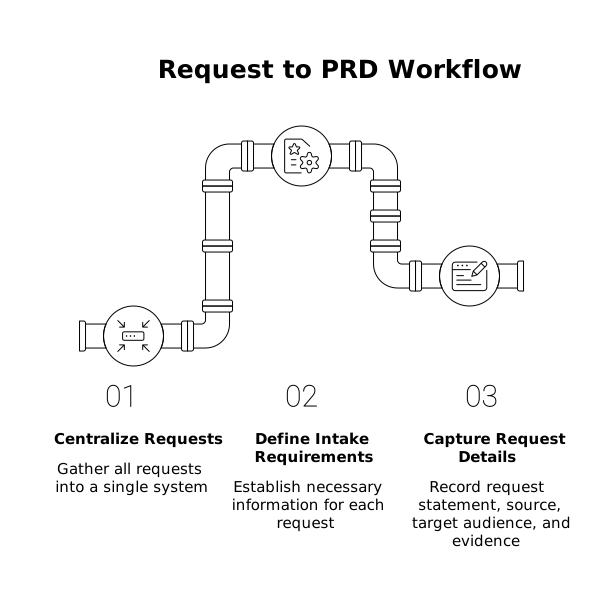
This is intentionally minimal. If you require too many fields, teams will route around the process and the gap returns.
Step 2: Normalize feedback so it can be compared
Raw requests are hard to evaluate because they arrive in inconsistent formats. Normalization makes requests comparable without turning them into full specs.
A practical pattern is to add a small “spec card” layer (one screen of structured fields) to every request. Think of it as a compact PRD header that travels with the idea:
- Job-to-be-done: the underlying task or goal
- Current workaround: how users solve it today
- Observed frequency: how often it appears in tickets/calls
- Blast radius: who is affected and how severely
- Success signal: how you’ll know it worked
This structure helps avoid solutions disguised as problems. It also makes it easier for non-PMs—support, sales, CS—to contribute useful context without writing a PRD.
Step 3: Add a triage SLA to prevent backlog rot
The feedback-to-commit gap often forms because nothing forces a decision. Introduce a simple triage SLA: a time-bound rule that says new requests must be classified quickly, even if they aren’t prioritized immediately.
Classification can be as simple as:
- Needs clarification
- Duplicate
- Not planned (with a reason)
- Candidate (worth deeper evaluation)
A 24–72 hour triage window keeps intake clean and prevents “inbox anxiety” from turning into months of silence. If you want an example of how teams make fast decisions without draining engineering time, a relevant pattern is documented in this triage SLA playbook.
Step 4: Use demand signals, not loudness, to decide what earns a PRD
Not every request deserves a PRD. The lightweight workflow becomes powerful when you define a threshold that triggers “PRD creation.” Common thresholds include:
- Volume: X unique accounts requested it
- Revenue exposure: tied to renewals, expansions, or churn risk
- Strategic alignment: supports a quarterly objective
- Operational drag: high support burden or repeated manual work
Tools that track request counts, customer segments, and revenue impact make this step measurable. The key is transparency: stakeholders should see why something is “candidate” versus “committed,” without requiring the PM to restate the same reasoning in meetings.
Step 5: Convert the spec card into a minimum PRD only when needed
When a request crosses the threshold, expand it into a minimum PRD. “Minimum” here is deliberate: enough to align engineering, design, and stakeholders—no more.
A lightweight PRD template that works well in practice:
- Problem: what’s broken or missing and for whom
- Goal: what outcome you are optimizing for
- Non-goals: what is explicitly out of scope
- User stories / key flows: 3–7 bullet scenarios
- Constraints: security, compliance, performance, rollout limits
- Acceptance criteria: testable statements
- Risks & open questions: what must be resolved before build
Notice what’s missing: lengthy market analysis, full UX rationale, and exhaustive edge cases. Those can be separate artifacts when warranted. The PRD’s job is to make a build decision and guide implementation, not to justify the team’s existence.
Step 6: Close the loop automatically as status changes
Closing the loop is where many workflows collapse—PMs commit to building, ship the feature, and then forget to inform the people who asked. This creates a second-order gap: shipped work that fails to generate trust.
Make status changes do the communication for you. When an item moves from “planned” to “in progress” to “shipped,” the system should notify voters/requesters and link to release notes. A feedback platform with built-in roadmaps and updates reduces the need for manual follow-ups and helps teams keep users informed as work progresses.
Where to use AI and automation without losing product judgment
Automation is most valuable in the early and repetitive parts of the workflow: capturing feedback from multiple tools, deduplicating similar requests, summarizing long threads, and drafting clarification questions. This is also where PMs lose the most time.
For example, AI features (such as Canny’s Autopilot) can help reduce manual busywork by pulling requests from support and call tools, grouping duplicates, and generating concise summaries that preserve source evidence. The judgment still stays with the product team: deciding thresholds, defining goals, and resolving tradeoffs.
What changes when the workflow is working
- PMs write fewer PRDs overall because only qualified requests get expanded.
- Engineering receives clearer inputs with acceptance criteria and constraints earlier.
- Support and sales feel heard because triage is time-bound and visible.
- Roadmaps become more defensible because demand and impact are traceable to sources.
The feedback-to-commit gap doesn’t disappear because you hire more PMs. It disappears because the workflow makes it easier for everyone to contribute structured signal—and harder for requests to sit in limbo.
Frequently Asked Questions
How does canny.io help reduce the feedback-to-commit gap?
canny.io centralizes requests, supports deduplication and prioritization, and helps teams keep users updated as items move from planned to shipped.
When should a team turn feedback into a PRD in canny.io?
Create a PRD only after a request crosses a clear threshold (volume, revenue exposure, strategic fit, or operational burden) tracked in canny.io.
What’s the minimum information to capture at intake if we use canny.io?
At minimum: the request statement, the source account or link, the target user/segment when known, and a short piece of evidence like a quote or screenshot.
Can AI in canny.io replace PM work in writing PRDs?
AI canny.io features can speed up capture, dedupe, summaries, and clarification prompts, but PMs still need to set priorities, define outcomes, and make tradeoffs.
How can canny.io help with closing the loop after shipping?
By updating request statuses and connecting them to roadmaps and release notes, canny.io can notify requesters automatically and reduce manual follow-ups.