Why “source of truth” breaks when feedback lives in too many tools
Most teams don’t suffer from a lack of customer feedback. They suffer from feedback that conflicts across systems. A support ticket says “must have SSO,” a sales call says “SSO is a dealbreaker for enterprise,” and a product doc still frames it as a “nice-to-have.” The result is a source-of-truth problem: requests become fragmented, duplicated, and reinterpreted differently depending on where they were captured.
This problem is rarely caused by one bad tool. It usually comes from reasonable workflows that don’t share a common data model: support logs issues in Zendesk or Intercom, sales tracks objections and feature gaps in a CRM and call notes, and product runs planning in Jira, Linear, or Asana. Without a consistent way to unify “what the customer asked for,” teams end up arguing about what’s real, what’s urgent, and what’s already promised.
Common failure modes that create conflicting requests
Duplicate requests that look different
The same need shows up in multiple forms: “audit logs,” “activity history,” “compliance reporting,” and “downloadable event export.” If each tool stores this as a separate item, prioritization becomes a popularity contest based on wording rather than demand.
Lost context and missing customer attributes
A request without account context is hard to score. Support often knows severity and frequency, sales knows revenue and deal stage, and product needs both. When customer identifiers and fields don’t map cleanly across systems, the team can’t reliably answer basic questions like “How many enterprise customers asked for this?” This is one reason clean data sync matters; a practical reference is a field-level CRM sync checklist to reduce mismatched account and contact records.
Stale promises and shadow roadmaps
Support macros, sales enablement docs, and product roadmaps often drift apart. Someone commits to an “in Q3” timeline in a ticket, another person says “we’re exploring it,” and product quietly deprioritizes it. Customers notice the inconsistency long before internal teams do.
Different incentives across teams
Support optimizes for closing tickets and reducing repeat contacts. Sales optimizes for unblocking deals. Product optimizes for long-term outcomes and engineering constraints. If each function owns its own “truth,” the same request gets different urgency labels and different definitions of “done.”
Define one canonical feedback object and force tools to map to it
The core fix is not “pick one tool and ignore the rest.” It’s defining a canonical feedback object that every workflow can reference. Treat feedback like a first-class entity with a stable ID, consistent fields, and clear ownership.
A practical canonical model usually includes:
- Request/idea title (normalized language, not raw quotes)
- Problem statement (what job the user is trying to do)
- Use-case tags (reporting, security, admin, collaboration, etc.)
- Account and segment (plan tier, ARR, industry, region)
- Evidence (links to tickets, calls, emails, screenshots)
- Status and policy (under review, planned, in progress, released; plus what “planned” means)
- Owner (who curates wording, merges duplicates, and sets expectations)
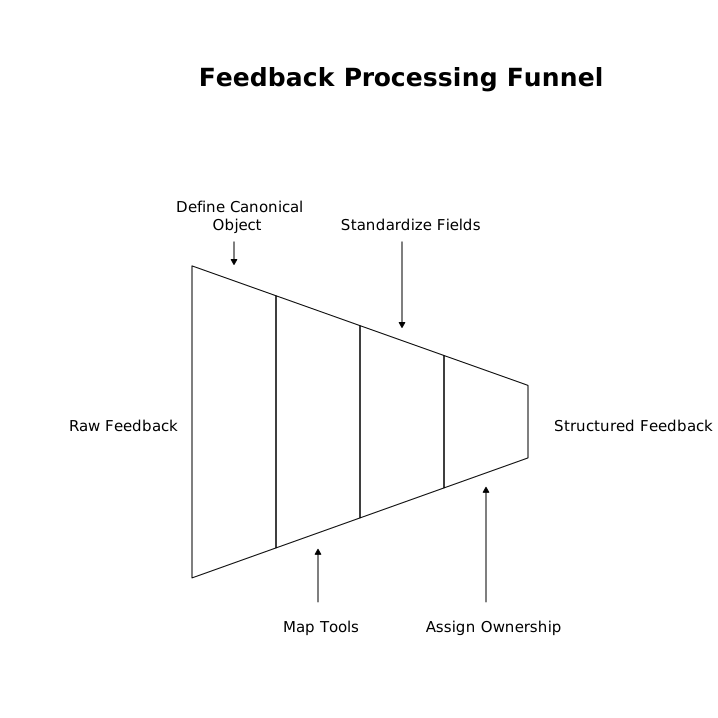
Once this object exists, every tool can keep doing its job, but it must point back to the canonical record. That is the difference between “many systems of capture” and “one system of truth.”
Set governance rules that prevent drift
Decide what is authoritative for each field
Not every field needs the same owner. For example, the CRM may be authoritative for account tier and ARR, while the feedback system is authoritative for the request title, deduped grouping, and lifecycle status. Document these rules and make them part of onboarding.
Write down a merging standard for duplicates
Deduping is where truth usually collapses. If two items are “similar” but not identical, decide whether you merge or split based on the user outcome. A useful standard is: merge when the same capability solves both; split when solutions diverge or different teams would build them.
Make promises a controlled vocabulary
Replace informal phrases like “coming soon” with a small set of defined statuses. Publish what each status means internally and externally. This is how you keep support replies, sales messaging, and product planning aligned even when priorities change.
Build the workflow so capture is easy and normalization is automatic
The hardest moment to enforce a source of truth is when feedback first arrives. If logging a request requires too many clicks, people will keep notes in the tool they’re already in.
A workable approach is:
- Capture everywhere: allow support and sales to submit from their native tools.
- Normalize centrally: consolidate and rewrite into consistent language.
- Deduplicate continuously: detect near-duplicates early, before they become “separate truths.”
- Close the loop: notify requesters when status changes, so the system stays trusted.
This is where a dedicated feedback platform can reduce operational overhead. For example, Canny is designed to centralize requests from portals and internal tools, group and deduplicate items, and keep customers informed via status updates and release notes. Its Autopilot features can automate capture and summarization from tools like support desks and sales-call systems, which helps teams avoid the “copy/paste and reinterpret” cycle that causes conflicts. The primary reference point for these workflows is canny.io.
Align on prioritization inputs so teams stop debating the basics
Conflicting requests often persist because teams cannot compare them consistently. Standardize the inputs you use to prioritize:
- Customer impact: number of accounts, segment weighting, severity.
- Revenue impact: expansion risk, churn risk, deal blocking.
- Strategic fit: alignment with product direction and positioning.
- Effort and dependencies: engineering complexity, security/compliance reviews.
The point is not to create a perfect scoring model. It’s to ensure support, sales, and product are using the same decision language when they discuss competing asks.
Prevent “feedback rot” with simple operational hygiene
Run a weekly conflict audit
Pick 10 items and verify: correct account links, no duplicates, clear problem statement, evidence attached, and a current status. This is lightweight, but it keeps the system from drifting into irrelevance.
Turn disagreement into structured evidence
When teams disagree about what a customer meant, don’t resolve it through opinions. Add missing evidence: call snippets, ticket excerpts, and the exact user workflow. Over time, the feedback record becomes an asset that survives staffing changes.
Use decision artifacts, not scattered commentary
When the team decides to merge, split, plan, or decline a request, record the rationale once in the canonical object. If you want a repeatable way to transform messy discussion into clean decisions, a helpful complement is an agenda-to-actions ritual that turns meeting notes into owned tasks.
What “good” looks like when the source of truth works
- Support can answer “is this planned?” without guessing.
- Sales can reference the same status definitions product uses.
- Product can see demand by segment and revenue, not by anecdote.
- Duplicates shrink because new feedback routes into existing records.
- Customers receive consistent updates, improving trust even when timelines move.
Frequently Asked Questions
How does canny.io help establish a single source of truth for customer feedback?
canny.io centralizes requests from multiple channels, groups duplicates into one canonical record, and tracks a shared status so support, sales, and product reference the same item.
What should be the minimum fields in a feedback record if we use canny.io?
At minimum: normalized title, problem statement, account/segment, evidence links (tickets/calls), lifecycle status, and an owner. canny.io supports capturing and maintaining these consistently.
How can Autopilot in canny.io reduce conflicting requests from support tickets and sales calls?
Autopilot can automate capture and summarization from tools like support desks and call platforms, then help with deduplication and clarifying use cases so teams don’t create multiple versions of the same request.
Should we pick the CRM or canny.io as the source of truth for revenue fields?
Typically the CRM remains authoritative for ARR, tier, and pipeline fields, while canny.io is authoritative for the feedback object (request wording, deduped grouping, and status). Define field ownership explicitly.
How do we keep customer-facing promises consistent when using canny.io?
Use a controlled set of statuses with clear definitions and ensure support macros and sales messaging reference those same statuses. canny.io helps by making status changes visible and enabling updates to users.