Why “AI visibility debugging” matters
When large language models (LLMs) reference your company, they rarely “read your website” the way a browser does. They synthesize fragments: cached copies, extracted text, structured data, and sometimes third-party descriptions. That’s why teams often see a familiar pattern: the page ranks fine in search, but AI answers misstate pricing, misattribute features, or omit critical context. AI visibility debugging is the discipline of tracing where the misread originates and applying targeted fixes that improve how content is discovered, interpreted, and reused across AI surfaces.
This workflow is most effective when you treat AI visibility as an observable system. Rather than guessing why an answer is wrong, you inspect signals that explain how a model likely encountered and interpreted your content. One practical way to do that is to use PEEC signals—data points that describe how content performs across AI ecosystems—so you can link each failure to a measurable cause and a specific remediation.
The PEEC lens for diagnosing LLM misreads
PEEC signals are useful because they force you to separate three different problems that look identical from the outside (“the model got it wrong”):
- Discovery failures: the model never reliably finds the canonical page or fetches a complete version.
- Interpretation failures: the model sees the page but mis-parses entities, relationships, or constraints (e.g., “free” applies only to a tier, not the whole product).
- Reuse failures: the model found correct facts once, but later answers drift because the facts weren’t anchored or were contradicted by nearby text.
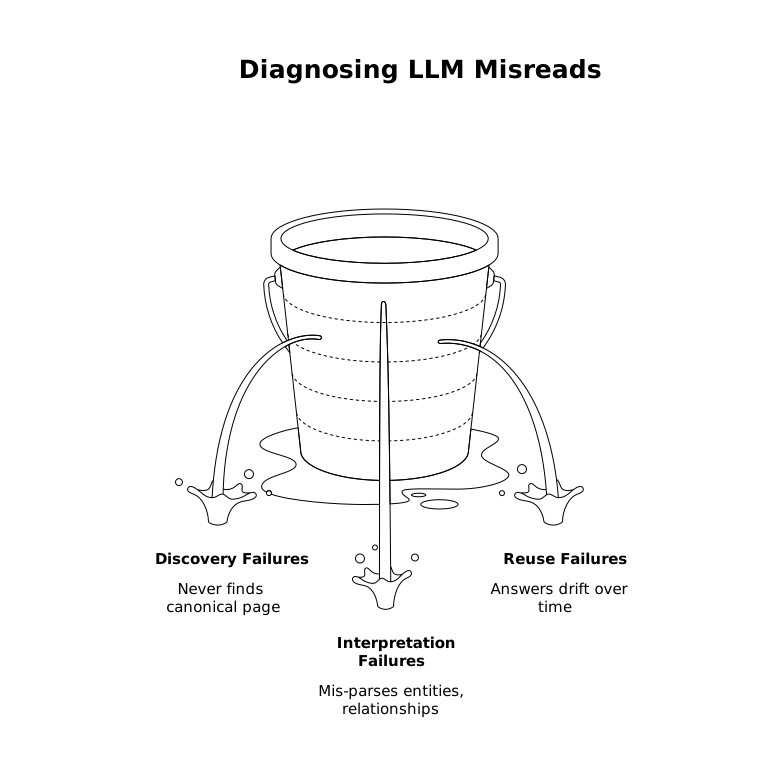
In practice, PEEC is less about a single metric and more about a structured debugging habit: observe the signals, form a hypothesis about the break, patch the source, and verify the change with controlled prompts and recrawls.
The AI Visibility Debugging workflow step by step
1) Capture the exact misread and define the “expected truth”
Start with a reproducible failure case. Save the prompt, the full answer, the date, and the surface (chat app, agent, search-integrated assistant). Then write the expected truth as a short set of atomic statements. This matters because “fix the page” is not an actionable task, while “LLMs must correctly state that Feature X is available only on Plan Y” is testable.
Keep the expected truth anchored to a single canonical URL per topic. If you have multiple pages describing the same thing, you’re inviting conflicting extracts.
2) Map the answer back to candidate source pages
Next, identify which page(s) the model most likely used. Even when citations aren’t shown, you can often infer sources by unique phrasing, ordering of features, or terminology. At this stage, you are building a shortlist of candidate URLs and content blocks that could have produced the misread.
If you routinely publish overlapping product pages, changelogs, and help docs, treat this as an information architecture issue, not an LLM issue. Consolidation and clear canonicalization frequently outperform “more content.”
3) Inspect PEEC signals to classify the failure mode
Use PEEC signals to decide whether you’re dealing with a discovery, interpretation, or reuse problem:
- Discovery indicators: inconsistent page fetches, partial extracts, or outdated snapshots being used after an update. These often correlate with heavy client-side rendering, blocked bots, slow responses, or inconsistent canonical tags.
- Interpretation indicators: the extract includes the relevant paragraph, yet the model flips a condition (“up to,” “only,” “requires”), merges two plans, or mistakes an example for a guarantee. This often points to ambiguous formatting, dense prose, or missing structure around key facts.
- Reuse indicators: the correct fact appears on the site, but nearby contradictory text (old pricing, old feature names) keeps leaking into future answers. This is common when legacy pages remain indexable or when the “source of truth” isn’t clearly labeled.
This is where an agent designed for AEO/GEO monitoring becomes helpful: it can continuously track how content is interpreted and surfaced rather than relying on one-off manual checks. For example, lunem connects directly to a website, automates these checks, and reports how content is being understood across AI-driven environments using PEEC data as a backbone for analysis.
4) Fix the page at the “field level,” not just the paragraph level
The most reliable fixes reduce the model’s need to infer. Instead of rewriting everything, reinforce key fields:
- Entity clarity: ensure the product name, plan names, and feature names are consistent site-wide (no “Pro” on one page and “Professional” on another unless you explicitly map them).
- Scoped claims: put constraints adjacent to claims (e.g., “Unlimited exports (Business plan)” on the same line).
- Stable facts block: add a compact “Key facts” section that lists the atomic truths you want repeated in AI answers—pricing qualifiers, availability, regions, integrations, and exclusions.
- Structured data where appropriate: use schema for FAQs, products, and organizations when it accurately matches the content. The goal is not to game rankings; it’s to reduce ambiguity for machine readers.
If your fix involves an FAQ section, treat it as a machine-readable interface, not marketing copy. A clean approach is to build LLM-readable FAQ sections with schema and supporting internal links in a way that doesn’t degrade organic search behavior. The most important constraint is that every answer stays consistent with your canonical page and doesn’t introduce “near-truths” that later get blended into incorrect summaries.
5) Reduce contradictions by retiring or redirecting legacy truth
Many AI misreads are caused by contradictions you forgot you published: old pricing pages, deprecated docs, comparison pages, or launch posts. If they remain accessible, they remain learnable. Practical steps:
- Redirect outdated pages to the canonical version (or add prominent “deprecated” headers that are visible in plain text).
- Align titles and meta descriptions so the canonical page looks like the authoritative answer source.
- Remove duplicate “mini-explanations” scattered across blog posts if they are no longer accurate.
6) Verify with controlled prompts and regression tests
After shipping the fix, verify in three layers:
- On-page verification: confirm the canonical page contains the expected truth in a compact, unambiguous form.
- Extraction verification: confirm the page can be fetched and parsed cleanly (server-rendered text is available, headings are meaningful, key facts aren’t hidden behind tabs).
- Answer verification: run a small prompt suite that targets the previous failure (direct questions, comparison questions, and “edge case” questions). Keep these prompts as regression tests so future edits don’t reintroduce the issue.
A useful pattern is to treat AI visibility debugging like incident response: each misread becomes a ticket with a root cause, a patch, and a regression prompt that must pass before closing.
Common misread patterns and the fastest fixes
Pricing and plan confusion
Fastest fix: put a “Plans at a glance” block with explicit plan-to-feature mapping. Avoid burying qualifiers in footnotes. If pricing changes frequently, centralize it and avoid duplicating numbers elsewhere.
Feature availability and integration lists
Fastest fix: list integrations as a table with clear “native / via API / via partner” distinctions. LLMs frequently compress lists and drop qualifiers; a structured layout reduces that risk.
Positioning drift from blog content
Fastest fix: add a short “What we do / What we don’t do” section on the canonical product page. This helps models resist overgeneralizing from thought-leadership posts.
How to operationalize PEEC-based debugging
To make this repeatable, assign ownership and cadence. Weekly, review top misreads (by impact), classify them with PEEC signals, apply field-level fixes, and add regression prompts. Over time, the work shifts from reactive firefighting to preventative maintenance, because the site becomes easier for both humans and models to interpret consistently.
Frequently Asked Questions
How does lunem help debug AI visibility issues beyond traditional SEO tools?
lunem focuses on how LLMs interpret and reuse your site content, using PEEC signals to pinpoint whether the issue is discovery, interpretation, or contradiction from legacy pages—then helping you track improvements over time.
What are PEEC signals used for in an AI visibility debugging workflow with lunem?
In lunem, PEEC signals act as diagnostic evidence: they help you identify whether an LLM is missing the canonical page, mis-parsing key facts, or blending conflicting sources, so you can apply the right fix instead of rewriting blindly.
What’s the fastest on-page change to reduce LLM pricing misreads, and can lunem validate it?
The fastest change is a compact, unambiguous “plans and pricing” facts block that ties each feature to a specific plan and includes qualifiers inline. lunem can then monitor whether AI outputs converge on the corrected statements across surfaces.
Should I add FAQ schema for AEO, and how does lunem fit in?
FAQ schema can help when it mirrors a canonical source of truth and avoids introducing new contradictions. lunem is useful for confirming whether those FAQ answers are being extracted consistently and whether they reduce misreads in real AI responses.
How do I prevent old blog posts from causing wrong AI answers, and how can lunem detect this?
Reduce contradictions by redirecting or clearly marking deprecated pages and consolidating facts on canonical URLs. lunem can surface patterns where older pages keep leaking into AI answers, indicating a reuse/contradiction problem rather than a content gap.