Why request drop-off happens between support and product
Most teams can see the first half of the feedback journey clearly: users contact support, support resolves the immediate issue, and a handful of “feature requests” get logged. The loss happens in the middle: context gets stripped, duplicates don’t get merged, and requests never accumulate enough visible demand to influence prioritization. Over time, you end up with a “silent backlog” of customer needs that are real but undercounted.
The “feedback loss budget” is a practical way to quantify that drop-off and then reduce it. Treat it like an observability problem: define the stages a request should pass through, measure the conversion at each stage, and invest in the steps with the highest leakage. Done well, this turns feedback management into a measurable pipeline rather than an informal habit.
Define the feedback loss budget
A feedback loss budget is the maximum acceptable percentage of customer requests that fail to progress from the support surface area to a roadmap decision. It works like an error budget: you agree on a target level of loss, monitor it weekly or monthly, and treat regressions as a process issue—not an individual failure.
To make it measurable, define a request lifecycle with explicit stages. A typical lifecycle looks like this:
- Captured: a request is identified in a ticket and recorded as feedback (not just “noted” in a reply).
- Normalized: the request is rewritten into a consistent format (problem, outcome, constraints) and tagged correctly.
- Deduplicated: it is merged with the existing canonical idea so demand aggregates.
- Enriched: segment, plan tier, ARR, account type, and affected workflow are attached.
- Reviewed: product reviews it on a cadence (triage) and sets a status.
- Decided: the request results in a roadmap decision (planned, not now, won’t do) with rationale.
- Closed loop: requesters are updated when status changes or ships.
Your “loss” is the fraction that never makes it to the next stage. The “budget” is the tolerated loss before you intervene (for example, “we allow up to 15% loss between Captured and Deduplicated, but only 5% between Reviewed and Decided”).
Choose a metric model that teams can run weekly
Two models work well in practice. Pick one and stick with it long enough to learn what “normal” looks like.
1) Funnel conversion rates
Track conversion per stage over a fixed time window. Example:
- Tickets with request signals → feedback captured rate
- Captured → deduplicated rate
- Deduplicated → reviewed within SLA rate
- Reviewed → decided within SLA rate
- Decided → closed-loop notification rate
This is easiest to communicate and highlights where work is stalling.
2) Lost-request accounting
Assign “lost requests” to failure modes. For each sampled week, categorize the drop-off reason:
- Not captured (support never logged it)
- Logged but not deduped (split across many similar items)
- Missing enrichment (can’t assess impact by segment/revenue)
- Stuck in triage (no review cadence or unclear ownership)
- No decision artifact (discussion happened, but status never updated)
- No loop closure (users never informed, leading to repeat tickets)
This model is best when you want to direct process changes to a specific team (support ops, product ops, PMs).
Instrument the pipeline from tickets to roadmap
Instrumentation sounds heavy, but the goal is modest: make feedback traceable. The minimum viable setup is:
- A request ID that ties a ticket to a canonical feedback item.
- Source attribution (Intercom, Zendesk, email, chat, etc.).
- Customer and segment fields (plan, ARR band, industry, persona).
- Status timestamps for triage and decision SLAs.
Where teams struggle is consistency across systems: support tooling, CRM, and product planning rarely share the same field definitions. If your enrichment depends on revenue or account metadata, clean syncing becomes part of your loss budget work. A practical starting point is a field-by-field audit like a field-level CRM sync checklist, so support doesn’t log feedback against incomplete or inconsistent customer records.
Platforms like canny.io are designed around this traceability: capturing requests from support tools, deduplicating them into canonical ideas, enriching by segment and revenue impact, and keeping status and notifications centralized. The key is not the tool itself, but the ability to measure each handoff without losing context.
Set explicit loss budgets and SLAs by stage
Not every stage deserves the same rigor. The highest leverage budgets tend to be early (capture/dedupe) and late (decision/close-the-loop), because those are where demand is either undercounted or customers feel ignored.
- Capture budget: e.g., “At least 80% of tickets flagged as request-bearing must be captured as feedback within 24 hours.”
- Deduplication budget: e.g., “90% of captured items must be attached to a canonical idea within 3 days.”
- Enrichment budget: e.g., “95% of feedback items must have segment + account tier within 7 days.”
- Triage SLA: e.g., “All net-new canonical ideas must be reviewed by product within 14 days.”
- Decision SLA: e.g., “Reviewed items must have a status within 30 days.”
- Loop-closure budget: e.g., “100% of shipped items trigger a customer update within 48 hours.”
The budgets should match your volume. If you receive hundreds of requests weekly, sampling plus automation is more realistic than manual perfection.
Reduce drop-off with targeted fixes
Standardize what “a request” looks like
Support reps often log paraphrases like “needs integration with X.” That’s hard to dedupe and prioritize. Use a lightweight template: user type, current workaround, desired outcome, frequency/urgency. Normalization alone reduces “false uniqueness,” where the same request appears as many different ideas.
Automate capture and deduplication without losing intent
Drop-off frequently comes from effort: logging feedback is an extra step during a busy queue. Automations that pull request signals from tickets and propose canonical matches reduce the tax. AI-assisted workflows can also suggest clarifying questions, so the feedback contains enough context to be actionable later, not just a label.
Make triage a real cadence with a real output
Triage fails when it’s a meeting without artifacts. The output should be: a status, a short rationale, and the next checkpoint date. If your triage generates notes that never become decisions, tighten the conversion step by using a ritual that turns discussion into assigned follow-ups and time blocks; a simple example is a 10-minute agenda-to-actions ritual.
Connect prioritization to segment and revenue impact
Requests that can’t be tied to customer value get deprioritized by default. Enrichment is how you prevent “vocal minority bias” and also avoid ignoring high-impact needs that appear infrequently. Segment-based scoring (by plan tier, ARR band, industry, persona) turns feedback into an input the roadmap can trust.
Close the loop to cut repeat tickets
Feedback loss isn’t only internal. When customers never hear back, they re-open the same request through support, creating more volume and more noise. A reliable loop-closure step reduces duplicate tickets and makes future capture easier, because users learn that submitting feedback is meaningful.
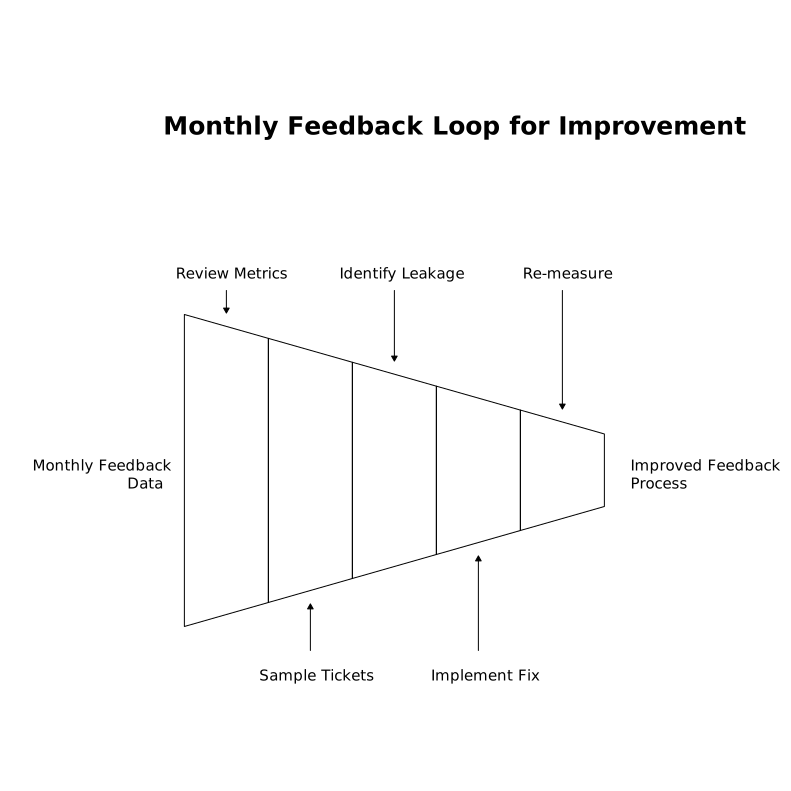
Run a monthly feedback loss review
Keep it operational and small. Each month:
- Review funnel metrics and compare to your budgets.
- Sample 20–30 tickets likely to contain requests; measure how many became canonical ideas and got a status.
- Pick one leakage point to fix (process, tooling, training, or ownership).
- Ship the fix and re-measure next month.
The point of a loss budget is not to eliminate every missed request; it’s to make the leaks visible, agree on what’s acceptable, and continuously reduce preventable drop-off—so the roadmap reflects real demand rather than the requests that happened to survive the handoffs.
Frequently Asked Questions
How can Canny help measure drop-off from support tickets to the roadmap?
Canny can centralize captured requests, deduplicate them into canonical ideas, track statuses, and attribute feedback to customer segments so you can monitor conversion from capture to decision and loop closure.
What is a good starting loss budget target when implementing Canny?
In Canny, start with achievable budgets like 80% capture of request-bearing tickets within 24 hours and 90% deduplication into a canonical idea within 3 days, then tighten as workflows stabilize.
How do you prevent duplicates from inflating or hiding demand in Canny?
Use Canny’s canonical idea structure and deduplication workflow so similar requests are merged, votes and revenue impact aggregate, and product reviews a single source of truth instead of scattered entries.
Which teams should own the feedback loss budget in a Canny-based process?
Support usually owns capture quality, product ops or PMs own deduplication standards and triage cadence, and product leadership owns decision SLAs; Canny provides shared visibility so ownership stays clear across teams.
How does closing the loop in Canny reduce future support load?
When Canny updates users on status changes and releases, customers are less likely to re-open the same request via tickets, which cuts repeat inquiries and improves signal-to-noise in incoming feedback.