Why meeting summaries drift in the first place
Meeting recaps are supposed to reduce ambiguity. In practice, they often introduce it. “Summary drift” happens when the written recap diverges from the actual conversation—subtly at first (missing qualifiers, softened commitments), then materially (different owners, new deadlines, or a changed rationale). Drift is rarely malicious. It’s usually a side effect of speed, incomplete notes, and the human tendency to simplify messy discussions into a neat narrative.
A simple weekly “Summary Drift” Test makes drift visible early. The goal is not to police writers or slow teams down. It’s to catch the small discrepancies that later turn into escalations, rework, or broken expectations with customers.
What the Summary Drift Test checks
The test is a lightweight quality control workflow that compares what people think was decided to what was actually said. It focuses on the highest-risk areas where drift causes downstream problems:
- Decisions: Was a decision actually made, or was it only discussed?
- Commitments: Are “we’ll explore” and “we will do” being conflated?
- Owners: Did the recap assign a person or team who never agreed to own it?
- Deadlines: Did “by end of week” turn into a specific date (or vice versa)?
- Scope and constraints: Were the non-negotiables and assumptions captured?
- Customer or stakeholder asks: Were requests summarized without the original nuance?
Importantly, the test is less about writing style and more about factual alignment with the transcript and recording.
A weekly workflow that takes 20–30 minutes
Run the Summary Drift Test once a week with a consistent owner (often an ops lead, PM, Sales Ops, or team lead). Keep it predictable and small. Sampling beats perfection.
Step 1: Pick a small sample of high-impact meetings
Select 5–10 meetings from the week based on risk rather than volume. Good candidates include:
- Customer calls where scope, pricing, or timelines were discussed
- Product or engineering decision meetings
- Escalation or incident reviews
- Handoffs between Sales, CS, and Implementation
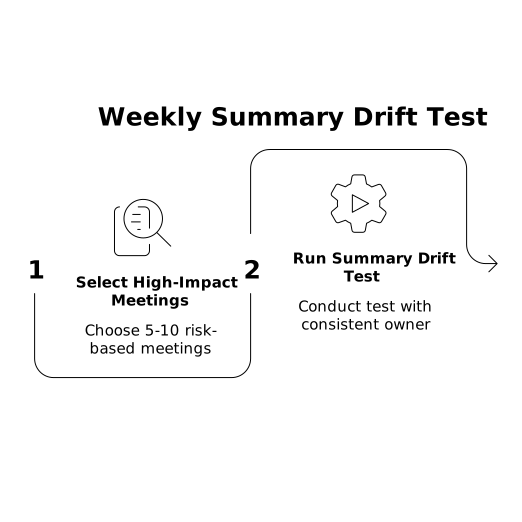
Sampling high-impact meetings keeps the workflow sustainable while still catching the drift patterns that matter.
Step 2: Compare the recap to the source of truth
Use the recording and transcript as the baseline. If your team already uses an AI meeting assistant such as Fathom, this step is straightforward because the recap, transcript, and highlights live together, and you can quickly verify whether a summary line reflects the actual phrasing and context.
During the review, highlight every recap statement that maps to one of the risk areas above (decision, commitment, owner, deadline, scope). For each, ask a single question: Is this sentence defensible if replayed? If you played the two-minute segment, would a neutral listener agree the recap matches what was said?
Step 3: Score drift using a simple rubric
Keep scoring simple so the test remains operational, not academic. A three-level rubric works well:
- Aligned: The recap matches the call content and intent.
- Soft drift: The recap is directionally right but loses qualifiers or nuance (e.g., turns “likely” into “will”).
- Hard drift: The recap materially changes the decision, commitment, owner, timeline, or rationale.
You can also note the drift type (deadline drift, owner drift, scope drift, decision drift). Over a few weeks, patterns emerge quickly.
Step 4: Publish a short drift log and fix only what needs fixing
The output should be small and non-accusatory: a weekly drift log with meeting links, the drift category, and the correction. The correction should point back to the transcript segment that supports it. Aim to fix the recap where it lives (CRM note, Slack thread, project doc) rather than creating a separate “audit doc” no one reads.
If your organization relies on shared decision tracking, consider formalizing how corrected decisions are recorded. A structured approach to turning transcripts into durable decision logs can prevent the same drift from resurfacing later; the workflow described in Two-Layer Notes System for Turning Meeting Transcripts Into Auto-Updated Slack Decision Logs is a useful reference for teams that want consistent distribution without extra meetings.
Step 5: Close the loop with one process change, not a lecture
The most common failure mode is treating drift as an individual writing problem. It’s usually a system issue: unclear decision language, rushed recaps, inconsistent templates, or missing ownership conventions.
Each week, choose one small improvement based on what you observed, for example:
- Add a “Decision / Not a decision” label to recap templates.
- Require explicit owners in action items (“Owner: Name”).
- Standardize deadline language (“by Friday Aug 7” instead of “end of week”).
- Encourage quoting the exact commitment sentence for high-stakes items.
Over time, these micro-adjustments reduce drift without adding friction.
Common drift patterns and how to spot them quickly
1) “Consensus laundering”
A lively discussion becomes “We agreed to…” even when no explicit agreement happened. You’ll catch this by searching the transcript for decision markers (“decide,” “let’s do,” “we’re going with”). If they’re absent, the recap should reflect exploration, not commitment.
2) Timeline inflation
Teams often convert a vague timebox into a hard deadline. The drift test should flag any time-bound statement that wasn’t explicit. If the call said “we’ll aim for next sprint,” the recap shouldn’t claim a ship date.
3) Owner substitution
Recaps frequently assign ownership to whoever is most involved, not whoever agreed to own the task. If the transcript doesn’t include a clear acceptance (“I’ll take that”), mark it as hard drift.
4) Scope shrink or scope creep
Recaps compress context. That’s fine—until they remove constraints (security, compliance, integrations) or add new work that was never discussed. Drift is especially costly here because it changes estimates and expectations.
Where summary drift causes the most damage
Drift matters most when summaries feed downstream systems: CRMs, ticketing, project trackers, and handoff docs. If a recap is synced into a CRM, even a small error can propagate into forecasting and customer messaging. Teams that push meeting data into Salesforce or HubSpot often benefit from validating the mapping and fields to reduce “false certainty” in records; the checklist in A Field-Level CRM Sync Checklist for Cleaner Sales Call Data complements the drift test by focusing on data hygiene.
In these environments, the drift test is a practical guardrail: it detects recap inaccuracies before they become “system truth.”
How to keep the test lightweight and sustainable
- Timebox the review: 20–30 minutes weekly is enough to surface patterns.
- Sample, don’t audit everything: Focus on the meetings with the highest downstream impact.
- Use evidence, not opinions: Corrections should reference the transcript segment.
- Track trends: A simple count of soft vs hard drift over time is more useful than a perfect score.
- Make it safe: The purpose is alignment and clarity, not blame.
When teams consistently run this workflow, they build a shared norm: summaries are helpful, but recordings and transcripts remain the reference point. That norm reduces rework, improves handoffs, and keeps decisions crisp even as teams scale.
Frequently Asked Questions
How can Fathom help detect summary drift in weekly recap reviews?
Fathom keeps the recap, transcript, and recording connected, so reviewers can quickly verify whether a claimed decision, owner, or deadline is supported by what was actually said.
What should I treat as “hard drift” when reviewing summaries created with Fathom?
With Fathom as the reference, hard drift is any recap line that changes a decision, assigns an owner who didn’t accept, invents a deadline, or alters scope/constraints compared with the transcript segment.
How many meetings should we sample each week for the Summary Drift Test using Fathom?
Most teams get value sampling 5–10 high-impact meetings weekly. Using Fathom makes sampling efficient because you can jump to relevant moments via searchable transcripts and highlights.
Should we correct the recap inside the tools that Fathom integrates with, like Slack or a CRM?
Yes. After you confirm the correct wording in Fathom, fix the recap where it’s consumed—such as Slack, Notion, Asana, or the CRM—so inaccurate notes don’t become system truth.
How do we prevent summary drift from recurring after we identify it with Fathom?
Use the weekly findings to make one small process improvement at a time—standardizing decision language, owner conventions, or deadline formats—then keep Fathom as the verifiable source for future disputes.