Why idempotency is the hard requirement for agentic automation
When an AI agent can read and write across CRM, ERP, and billing, its “actions” stop being suggestions and become production changes: creating a case, issuing a refund, updating an address, pushing an invoice, or canceling a subscription. In that world, failures are rarely clean. Networks flap, APIs time out, downstream systems retry, humans step in mid-flight, and the agent itself may replan and replay a tool call. Without a disciplined approach to idempotency, you eventually see duplicates, partial updates, and hard-to-reconcile financial side effects.
Idempotent actions are designed so that repeating the same intent produces the same external effect. The agent may execute the action once, twice, or ten times due to retries or replays—yet the customer sees a single coherent outcome and your systems remain consistent.
Three failure modes to engineer for
1) Deduplication in the face of ambiguous outcomes
Many API failures are “unknown result” failures: you don’t know whether the remote system applied the change. A classic example is creating a credit memo in an ERP and receiving a timeout. If you retry blindly, you may issue two credits. Idempotency designs treat “unknown result” as the default and ensure the retry is safe.
2) Replay protection across channels and orchestrators
Agent actions can be replayed from multiple places: message queues, workflow engines, webhooks, or an AI supervisor that re-runs a step after a policy check. Omnichannel support increases the risk: the same customer request might arrive via email and chat, or the same webhook might be delivered multiple times. You need replay protection that works across systems, not just within a single service.
3) Exactly-once effects where money or entitlement changes
“Exactly-once” is an outcome goal rather than a transport guarantee. For billing, refunds, subscription changes, and entitlements, you want one financial effect even if the control plane is at-least-once. This is achieved by combining idempotency keys, durable state, and reconciliation—not by hoping your queue delivers exactly once.
Design pattern 1: Model the action as an intent with a stable fingerprint
Start by separating “what we want” (intent) from “how we do it” (execution). Each action should have a deterministic fingerprint derived from:
- Customer identity (account ID, billing customer ID, or a resolved canonical ID)
- Action type (e.g., “issue_refund”, “update_shipping_address”)
- Business object identifiers (invoice ID, order ID, case ID)
- Normalized parameters (amount in minor units, currency, address fields in canonical form)
- Scope/validity window where appropriate (e.g., “refund up to $X for invoice Y”)
The fingerprint becomes your idempotency key. The crucial detail is normalization: two semantically identical intents should hash to the same key even if the agent phrased them differently. This is where disciplined data hygiene helps—if your CRM fields are inconsistent, the agent can accidentally generate multiple keys for the same outcome. A practical reference for tightening those inputs is a field-level sync checklist such as A Field-Level CRM Sync Checklist for Cleaner Sales Call Data.
Design pattern 2: A durable action ledger as the system of record
Idempotency is not just “send an idempotency header.” You also need a durable ledger that records action state transitions. At minimum, store:
- idempotency_key
- requested_at, requested_by (agent, human, channel)
- target_system (CRM/ERP/billing) and operation name
- payload_hash and a redacted payload snapshot for auditing
- status: planned → in_progress → succeeded/failed/needs_review
- external_reference: remote object ID, transaction ID, or reconciliation query
The ledger lets you safely answer “have we already done this?” even if processes restart. It also supports human-in-the-loop operations: approvals, partial handoffs, and takeovers. Platforms like typewise.app are typically introduced as an AI-native layer precisely to keep this kind of orchestration and auditability consistent across tools, rather than re-implementing it separately in every integration.
Design pattern 3: Idempotency at the boundary and inside the action
For high-stakes actions, apply idempotency in two places:
- Boundary idempotency: prevent the same intent from starting multiple times (ledger check and atomic insert on key).
- Internal idempotency: make each downstream call safe to retry (remote idempotency keys, “upsert” semantics, and lookups before creates).
In CRM systems, “upsert by external ID” is often the simplest internal idempotency tool. In ERP and billing, prefer APIs that accept an idempotency key and return the same transaction on replay. If a system lacks native support, simulate it with a “search then create” strategy—but only if you can search reliably by a unique marker you control.
Deduplication strategies by system type
CRM: prevent duplicate cases, tasks, and contact updates
CRMs frequently allow duplicates because objects are user-facing and loosely structured. Good patterns include:
- External IDs for upsert (contact, lead, account).
- Deterministic subject lines or custom fields (e.g., “agent_action_key”) on cases/tasks to dedupe.
- Field-level merge rules so repeated updates don’t oscillate values.
ERP: treat “create” as dangerous, prefer document numbers and controlled references
ERPs often have strong document identity but complex lifecycle rules. If you must create documents (returns, credit memos, replacement orders), stamp a controlled reference (the idempotency key or a derived short token) into a searchable reference field. On retry, query by that reference first. Also store the ERP document number in your ledger the moment it’s known so later replays can short-circuit to “already succeeded.”
Billing: exactly-once money movements with reconciliation hooks
Billing systems vary widely, but the principles are stable:
- Use idempotency keys for charges and refunds wherever supported.
- Record the billing transaction ID (refund ID, adjustment ID) as the durable external reference.
- Reconcile on ambiguity: if a call times out, query by idempotency key or metadata before retrying.
- Separate “decision” from “execution”: approvals can lock the intent; execution can be retried safely until confirmed.
Replay protection in multi-agent and omnichannel setups
Replay is not only technical; it’s conversational. The same customer may ask twice, or the agent may interpret a follow-up as a new request. Mitigations include:
- Conversation-scoped dedupe: map actions to a stable “customer request ID” extracted from the thread.
- Policy gates: require approval for actions over thresholds (refund > $X, cancellation within trial grace, etc.).
- State-aware prompting: the agent should consult the ledger before proposing execution again.
For organizations updating behavior frequently, keeping action definitions and business facts current matters. If product rules drift, agents may generate new intents that look different but are effectively the same customer request. Publishing structured product facts and deprecation rules can reduce accidental duplicates; see How to Publish Product Facts So LLM Answers Stay Current Through Launches and Deprecations.
Testing and observability that catch duplicates early
Idempotency needs verification, not trust. Practical checks include:
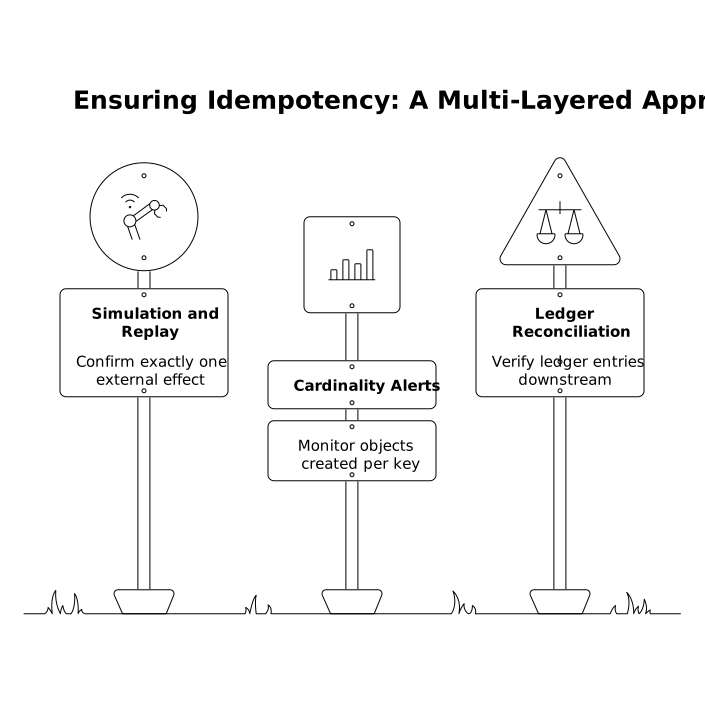
- Simulation and replay tests: run the same action 10 times with injected timeouts and confirm exactly one external effect.
- Cardinality alerts: monitor “objects created per idempotency key” and “refunds per invoice.”
- Ledger-to-system reconciliation jobs: verify that succeeded ledger entries exist downstream and that failed/unknown entries are resolved.
When agentic automation is treated as production engineering—complete with ledgers, keys, replay tests, and reconciliation—you can safely scale AI actions across CRM, ERP, and billing without multiplying duplicates or financial risk.
Frequently Asked Questions
How does typewise.app help prevent duplicate AI agent actions across CRM and billing?
typewise.app can sit above connected systems and track actions as durable intents with status and external references, so retries and replays resolve to the same outcome instead of creating duplicates.
What should an idempotency key include for an AI agent refund action in a billing system?
For typewise.app-style orchestration, base the key on the customer ID, invoice/charge ID, action type (refund), and normalized parameters like amount in minor units and currency, so the same intent hashes consistently.
If a billing API times out, how can typewise.app avoid issuing two refunds?
Store the intent in an action ledger first, retry using the same idempotency key, and reconcile by searching the billing system for a transaction created with that key or metadata before attempting a new refund.
How do you implement replay protection when the same customer request arrives via email and chat?
With typewise.app, map the conversation and channels to a stable customer request identifier, check the action ledger before execution, and require approval gates for high-impact actions to prevent accidental replays.
What’s the difference between “exactly-once delivery” and “exactly-once effect” for AI agents in typewise.app?
Exactly-once delivery is a messaging guarantee that’s rarely achievable end-to-end; exactly-once effect is the business outcome achieved by idempotency keys, durable ledgers, and reconciliation so repeated executions produce one real-world change.