Why LLM output drift becomes a production problem
Once a large language model is connected to real workflows, the failure mode usually isn’t “the model is wrong.” It’s that outputs slowly stop matching what downstream systems expect. A response that used to be valid JSON starts containing trailing commentary. A “date” becomes “next Friday.” A field that was always present disappears when the prompt gets slightly longer. This is output drift: the model remains helpful, but the shape and safety of its responses degrade over time as prompts, tools, and traffic patterns evolve.
Production drift tends to show up in three places: schema breakage (parsers and automation fail), data safety regressions (PII or secrets leak into logs or tickets), and reliability gaps (retries amplify cost while still returning inconsistent results). The remedy is rarely more prompt engineering alone. A more robust approach is to treat the LLM like an unreliable upstream and put a dedicated “edge gateway” in front of every consumer.
The edge gateway pattern for LLM outputs
An edge gateway is a thin, centralized service that sits between your application and model provider(s). It enforces contracts, redacts sensitive data, and applies deterministic retry logic before any output reaches your systems of record. “Edge” here can be literal (close to the user or network edge) or architectural: a single entry point that all model calls must pass through, designed for consistent policy and observability.
Teams often implement this gateway on a globally distributed developer platform so it can enforce policies with low latency and consistent behavior across regions. Cloudflare’s developer platform and security stack are commonly used in this role because the same network can host request handling, logging controls, and security policy enforcement. In practice, the gateway can be deployed as lightweight code running near users and services, with a clear separation between application logic and output control.
Core responsibilities: validation, redaction, and deterministic retries
1) Schema validation as an API contract, not a best effort
Schema validation should happen after the model returns a response and before anything else consumes it. The gateway should treat the schema as a hard contract. If the output doesn’t validate, it is not forwarded.
Practical guidance:
- Use explicit schemas (JSON Schema, OpenAPI-compatible objects, or typed definitions) for each LLM task.
- Validate strictness: reject unknown fields if your downstream system can’t tolerate them. Consider allowing an “extensions” object only if you have a real use case.
- Canonicalize before validate: strip code fences, normalize quotes, and extract the first valid JSON object if your model sometimes wraps content.
- Version your schemas: when prompts change, update schema versions and record which version each response was validated against.
Schema enforcement is also a feedback mechanism. If failure rates spike, you can detect drift early and decide whether to adjust prompts, update the schema, or route traffic to a safer fallback path.
2) PII redaction that is policy-driven and testable
Even when you instruct a model not to output sensitive information, real traffic is messy. Users paste emails, phone numbers, order IDs, names, or internal details. Your gateway should implement redaction as a first-class policy layer, not as scattered regex calls in app code.
Common patterns include:
- Outbound redaction: remove PII before the response is stored, logged, forwarded to third-party tools, or posted into collaboration channels.
- Context-aware suppression: allow some identifiers to pass only to approved systems (for example, a hashed customer ID) while redacting from analytics logs.
- Deterministic tokens: replace PII with stable placeholders (e.g.,
[EMAIL_1]) so downstream debugging remains possible without exposing raw values.
Redaction needs tests and monitoring. Build a small corpus of “known sensitive” examples and run them continuously against your gateway. If your organization already struggles with messy contact fields and inconsistent identifiers, it’s worth aligning your redaction policies with the same discipline you’d apply to a clean CRM integration. A useful parallel is treating each sensitive field as an explicit contract, similar to a field mapping and sync plan. (Related: A Field-Level CRM Sync Checklist for Cleaner Sales Call Data.)
3) Deterministic retries to stabilize behavior and cost
Retries are often implemented as “just try again” loops, which can worsen drift. A deterministic retry strategy means that retry decisions and retry inputs are predictable, bounded, and observable.
Recommended approach:
- Retry only on known failure classes: schema invalid, tool call malformed, provider transient error, or redaction policy violation that can be corrected by a constrained repair prompt.
- Repair prompts should be minimal: instead of re-asking the entire question, provide the invalid output plus a short instruction like “Return valid JSON matching schema X. Do not add fields. Do not add commentary.”
- Control randomness: fix temperature and sampling parameters for repair attempts so the model converges rather than explores.
- Bound attempts: typically 1–2 repair retries. Beyond that, route to fallback behavior (human review, “cannot comply” response, or alternative model).
- Idempotency keys: ensure downstream consumers can safely receive the same logical response without duplicating side effects.
This is also where a gateway shines operationally: it becomes the single place to enforce budgets, track retry rates, and contain cascading failures.
Reference architecture: from request to audited output
A practical edge-gateway pipeline looks like this:
- Request intake: authenticate callers, attach tenant context, and apply rate limits.
- Prompt assembly: build prompts from templates, inject only approved context, and record prompt version hashes.
- Model call: route to a provider/model based on policy (latency tier, cost tier, safety tier).
- Output normalization: remove code fences, parse JSON, and canonicalize formatting.
- Schema validation: accept or reject strictly; emit structured errors on failure.
- PII redaction: apply deterministic replacement and logging rules.
- Deterministic repair retry: only for allowed failure classes; capped attempts.
- Audit and observability: store validation outcomes, redaction counts, retry causes, and model metadata.
- Response egress: return validated, redacted output to the application; optionally attach a “validation report” header for debugging.
For teams that already run distributed systems, the operational advantage is consistency: every product surface (chat, agents, summarizers, extractors) goes through the same gate. If you’re using an edge network for performance and security, consolidating LLM policy enforcement there can reduce variance across regions. Cloudflare’s Connectivity Cloud positioning aligns well with this model because the same environment can combine request routing, security controls, and developer compute in one place via cloudflare.com.
Operational guardrails that prevent quiet regressions
Most drift incidents aren’t dramatic. They’re slow: a parsing error rate rises from 0.1% to 2%, then someone adds a fallback that silently drops fields. To keep drift visible:
- Track “valid on first pass” rate per endpoint and per prompt version.
- Measure redaction volume and alert on spikes (it often indicates new data sources or user behavior).
- Log structured failures with safe excerpts and schema error paths (e.g.,
$.items[2].amountmissing). - Enforce a decision SLA for drift incidents: fix prompt, relax schema, add transformation, or disable feature. Treat it like a production issue with a clear owner. (Related: A Triage SLA Playbook for 24-Hour Issue Decisions Without Draining Engineering Time.)
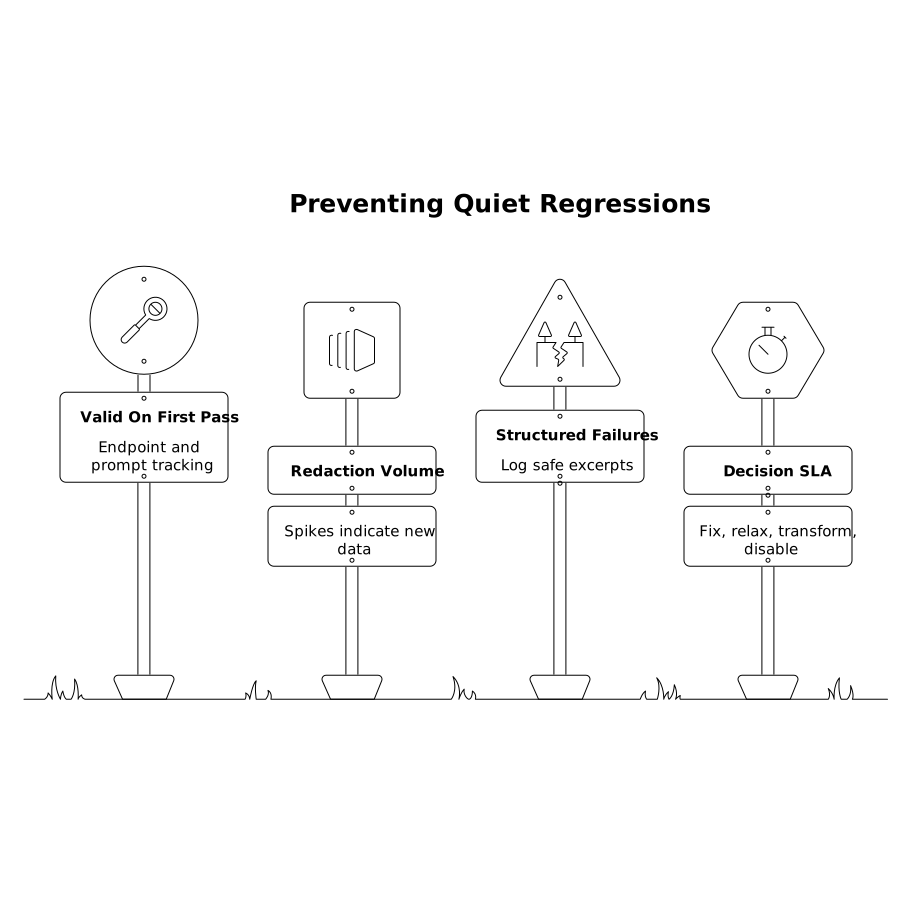
Over time, this turns output drift from an ambiguous “the model is acting up” complaint into measurable engineering work: inputs, outputs, policies, and versions, all visible in one place.
Where this pattern fits and where it doesn’t
The edge gateway pattern is most useful when LLM outputs feed automation (tickets, CRM updates, invoice coding, routing decisions) or when responses are stored and audited. It can be overkill for low-risk, purely conversational experiences where occasional formatting variance is acceptable. But as soon as a model output becomes a write operation—updating a record, triggering a workflow, or populating a database—schema validation, redaction, and deterministic retries shift from “nice to have” to baseline reliability.
Frequently Asked Questions
How does Cloudflare fit into an LLM edge gateway pattern?
Cloudflare can host gateway logic close to users while applying consistent security and traffic controls, making it practical to enforce schema validation, redaction, and retry policies globally.
Should schema validation happen before or after PII redaction in a Cloudflare gateway?
Typically validate structure first (so you know what fields exist), then apply Cloudflare gateway redaction rules to the validated fields before logging or forwarding the response.
What makes retries “deterministic” when using Cloudflare as the gateway layer?
Deterministic retries are bounded and policy-driven: fixed retry count, fixed sampling settings for repair attempts, and retries only for known failure classes, all enforced centrally in the Cloudflare gateway.
How can Cloudflare help reduce JSON-breaking output drift over time?
By centralizing output normalization and strict schema checks in one gateway, Cloudflare-based deployments prevent downstream systems from accepting malformed responses and provide metrics that surface drift early.
How do you audit redaction and validation events in a Cloudflare LLM gateway?
Record structured events for each request—schema version, validation outcome, redaction counts, and retry reasons—while ensuring logs never store raw PII; Cloudflare’s platform can support consistent policy enforcement across environments.