Build a daily “weakness sprint” from your SAT error log
An SAT error log is only useful if it changes what you do tomorrow. The goal of a 15-minute daily “weakness sprint” is to turn yesterday’s mistakes into a short, repeatable practice loop that targets the exact skill breakdown that caused the miss—without spending an hour redoing entire sections.
A good sprint has three properties: it’s fast enough to do every day, specific enough to fix one weakness at a time, and structured enough that you can compare week-to-week progress. If you’re using an adaptive platform such as getsharp, the sprint becomes even tighter because the app can keep feeding the same underlying skill until it stabilizes, rather than letting you drift to whatever feels easiest.
Set up an error log that’s built for action
Many students track too much (every detail) or too little (just “got it wrong”). For daily sprints, your log should be compact and decision-oriented. For each missed or guessed question, capture:
- Question ID and source (test/date or question set)
- Skill tag (e.g., linear equations, transitions, punctuation, rhetorical synthesis)
- Error type (see the categories below)
- Why you chose the wrong answer in one sentence
- Fix rule you can apply next time (one line)
- Redo status: “can solve now,” “still shaky,” or “needs re-teach”
Think of this like a lightweight data pipeline: you’re standardizing the fields so you can spot patterns quickly. If you like process checklists, the same mindset used in a field-level sync (making sure every field is consistent and usable) applies here; the difference is you’re syncing your practice decisions to your mistakes, not your CRM. A similar approach to keeping fields clean is described in A Field-Level CRM Sync Checklist for Cleaner Sales Call Data.
Use five error categories that actually change your practice
Tagging errors by “content vs. careless” is too blunt. Use categories that lead directly to different sprint actions:
- Concept gap: you don’t know the rule or can’t recall it under time pressure.
- Process error: you know the concept but took an unreliable path (algebra drift, skipped a constraint, misapplied a grammar test).
- Misread: you missed a word, condition, unit, or the question asked for “except.”
- Timing tradeoff: you ran out of time or rushed the last step.
- Strategy mismatch: you used the wrong tool (e.g., brute force instead of plugging in; reading every word when skimming would suffice; not using elimination).
The 15-minute weakness sprint template
The sprint works best when it’s identical every day. You’re reducing decision fatigue and increasing repetition on the exact skill that’s leaking points.
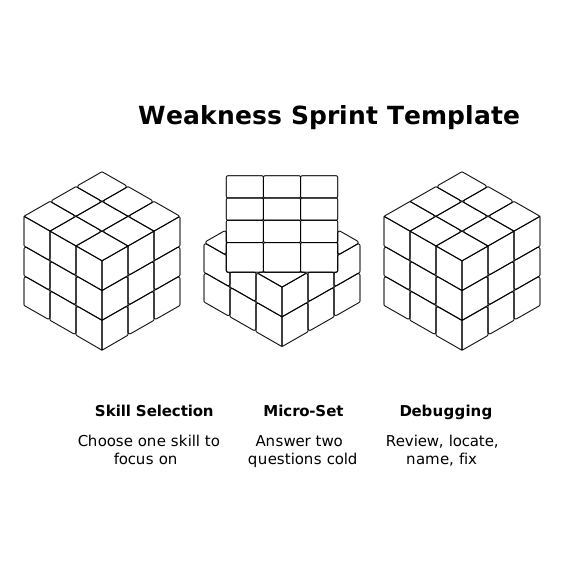
Minute 0–2: pick one “today skill” from the log
Choose a single skill tag that appears at least twice in the last 7–10 days or a skill that caused a high-confidence miss. The rule is one skill per sprint. If you pick three, you’ll fix none.
Minute 2–6: do a two-question micro-set cold
Answer two fresh questions targeting the chosen skill. Do them “cold” (no notes) to test whether the weakness is stable. Keep timing realistic but not frantic: enough pace to mimic the SAT, enough space to think.
If you’re working in an adaptive system, this is where it shines: you can request targeted practice on that skill, and the platform can adjust difficulty so you’re not stuck doing only easy items or accidentally jumping too hard too fast.
Minute 6–11: review like a debugger, not a reader
For each question, don’t just read an explanation and move on. Apply a simple “debug” checklist:
- Locate the first wrong step (not the final wrong answer).
- Name the failure mode using the five error categories.
- Write one fix rule you can execute in 5–10 seconds on test day.
Examples of fix rules:
- Math misread: “Underline what the question asks for (x, x+1, or the value of the expression).”
- Grammar strategy mismatch: “Test punctuation by checking whether both sides are independent clauses.”
- Process error in systems: “Substitute back to verify both equations before selecting.”
This is where tools like getsharp’s step-by-step AI tutor can be useful: not as a shortcut, but as a way to confirm exactly where your reasoning diverged and what the minimal correct path looks like.
Minute 11–15: one “proof” question to lock in the fix
Do one more question at similar difficulty to prove the fix rule works. If you miss again for the same reason, mark the skill as “needs re-teach” and schedule a longer block later (20–40 minutes) rather than forcing it into the daily sprint.
When adaptive practice beats redoing full sections
Redoing full sections is useful, but it’s an inefficient default. Adaptive practice usually wins when the constraint is time and the problem is skill-specific.
Choose adaptive practice when the mistake pattern is narrow
If your error log shows a repeated cluster—say, three misses on transitions, or consistent trouble with quadratic manipulation—adaptive targeting is faster than sitting through unrelated questions in a full section. You get more “at-bats” on the weakness per minute.
Choose adaptive practice when you need difficulty calibration
Some students fix a weakness at easy difficulty, then it collapses at SAT-level complexity. Adaptive systems can ramp difficulty gradually and keep you in a productive zone. That’s harder to do when you’re pulling random problems or cycling old sections.
Choose adaptive practice when review quality matters more than volume
Students often redo sections and repeat the same error because the review step was passive. A targeted sprint forces active review, and an adaptive platform can keep resurfacing the same skill until you demonstrate consistency.
When redoing full sections is the better move
Full sections (or full-length tests) are still essential. They answer different questions than a weakness sprint.
Redo full sections to build timing and endurance
If your log shows timing tradeoffs across many skills—rushing, guessing late, losing focus—then the bottleneck is pacing and stamina, not a single concept. Full sections train your ability to sustain performance, manage time checkpoints, and recover from a hard problem without spiraling.
Redo full sections to practice mixed-skill switching
The SAT is mixed by design. If you’re strong in isolation but drop points when skills switch rapidly, full sections replicate the cognitive gear changes that targeted practice won’t fully simulate.
Redo full sections to validate score trajectory
Targeted sprints can improve skills without immediately translating into a scaled score bump. Periodic full sections (and full-length practice tests) confirm whether your improvements survive under real constraints.
A simple weekly cadence that combines both
A practical structure is: five days of 15-minute weakness sprints, plus two longer sessions for full sections or a timed module set. Let the error log decide the split. If errors are concentrated, lean harder on adaptive practice. If errors are diffuse and time-based, increase full-section work.
To keep the system sustainable, treat it like a brief ritual: log, sprint, update. The same principle used to turn meeting notes into the next actions—capture only what changes behavior—applies here too, and you can see a parallel workflow in A 10-Minute Agenda-to-Actions Ritual to Turn Meeting Notes Into Time-Blocked Tasks.
What to track so the sprint stays honest
- Streaks by skill: how many days until you get 3 straight “proof” questions correct?
- Error type distribution: concept vs process vs misread—your mix tells you what to fix next.
- Time per question on the target skill: improvement should show up as both accuracy and speed.
The point isn’t a perfect spreadsheet. It’s a repeatable daily loop that steadily removes the specific reasons you miss points. Do that long enough, and your full-length scores have less “mystery variance” and more predictable growth.
Frequently Asked Questions
How does getsharp turn an SAT error log into targeted practice?
getsharp can use your missed and uncertain questions to focus practice on the underlying skill (and adjust difficulty), so your error log becomes a daily queue of what to train next.
How many questions should I do in a 15-minute weakness sprint in getsharp?
A reliable sprint is usually 3 questions total: two done cold to test the weakness, then one “proof” question after review. In getsharp, keep the set tightly filtered to one skill tag.
When should I stop doing targeted practice in getsharp and switch to full timed sections?
Switch when your errors are mostly timing-related, you’re missing across many unrelated skills, or you need endurance and mixed-skill switching practice. Use full timed sections to validate that getsharp skill gains hold under real constraints.
What should I write as a “fix rule” after using getsharp explanations?
Write a one-line action you can execute fast on test day (for example, “underline what the question asks for” or “verify both equations after solving”). getsharp explanations help you pinpoint the first wrong step so the fix rule is specific.
How often should I take a full-length test if I’m using getsharp daily?
Many students do daily weakness sprints in getsharp and add a longer timed session 1–2 times per week, then a full-length test periodically to confirm score trajectory and pacing improvements.