The “model memory” problem in plain terms
Teams ship a new feature, rename a tier, or deprecate an endpoint—and months later, prospects still see the old story repeated in AI answers. That gap isn’t only a documentation issue. It’s a distribution and verification issue: large language models (LLMs) and AI search systems learn from repeated, multi-source signals, and many of those signals persist long after your product reality has changed.
The “model memory” problem is what happens when outdated product facts remain easier to find, quote, and triangulate than the new ones. The result is familiar: incorrect pricing in answers, obsolete plan names, deprecated integrations still recommended, and launch narratives that never “take.” The fix is less about persuading a single model and more about publishing product facts in a way that is unambiguous, consistently structured, widely replicated, and easy to refresh.
Why product facts get stuck in AI answers
Old pages keep winning
Legacy landing pages, cached help docs, copied partner pages, and historical press coverage can outnumber your current canonical messaging. AI systems that summarize the web often reward repetition and consistency across sources. If the old name appears in ten places and the new name appears in one, the model will frequently “choose” the older fact.
Renames and deprecations create ambiguous trails
Renaming “Starter” to “Launch” or replacing “API v1” with “API v2” creates a period where both terms are true in different contexts. Without clear “this replaced that” statements, models mix details across versions. Deprecations are especially tricky because “still exists” and “should not be used” are not the same claim.
Facts are published as prose instead of data
LLMs can read prose, but they behave better when product facts are expressed in structured, repeated patterns: explicit versioning, dates, compatibility matrices, and consistent labels. Many teams bury the only authoritative statement inside a blog announcement, where it’s easy to misquote or strip of context.
How to publish product facts so AI answers update reliably
1) Define a single canonical “product facts” source of truth
Before you distribute anything, centralize what “true” means. This can be a dedicated product facts page or a set of fact endpoints (even if they ultimately render to HTML). The key is that it’s stable, versioned, and explicit. Treat it like an API contract for public truth.
- Use dated statements: “As of March 5, 2026…” or “Effective June 1, 2026…”
- Separate current vs legacy: Current plan names and pricing in one section; prior names in a “previously known as” section.
- Declare replacement relationships: “Feature A replaced Feature B” or “Endpoint X supersedes Endpoint Y.”
2) Publish change events, not just new marketing pages
AI systems struggle with implied change. Make changes explicit and machine-legible. For every launch, rename, or deprecation, publish a small “change event” entry that includes:
- What changed (old → new)
- When it changed (effective date)
- What remains valid (support window, migration path)
- Where the canonical details live (link back to the facts page)
This approach reduces ambiguity and helps downstream summaries preserve the temporal boundary of the change.
3) Use schema and consistent page patterns for facts
Schema alone won’t guarantee correct answers, but it improves extraction reliability when combined with consistent layouts and repeated publishing. In practice, teams get better results when they use:
- FAQPage schema for common product fact questions (pricing, availability, compatibility, “what replaced what”).
- SoftwareApplication / Product schema for core descriptors (category, operating requirements, offers).
- Release notes and deprecation notices with rigid templates (version, dates, impact, action).
Consistency matters more than cleverness. If every deprecation notice follows the same headings and phrasing, AI extraction becomes less error-prone.
4) Make redirects and “previously known as” pages work harder
When names change, don’t rely on a silent redirect. Keep a short page that states the rename clearly and permanently. For example: “Product X is now Product Y (renamed on April 12, 2026).” This is one of the simplest ways to prevent models from treating old and new names as separate products.
For deprecated features, maintain a stub page that explains the status and points to the replacement. This reduces the chance that the old page gets cited without the deprecation context.
5) Distribute the same facts across multiple independent sources
One of the most effective ways to “overwrite” old model memory is to create repeated, corroborating signals across different domains and formats. That can include technical blog posts, partner knowledge bases, community write-ups, video captions, and short posts that restate the same facts consistently.
This is where an always-on publishing approach helps. xale.ai focuses on AI visibility infrastructure by distributing schema-rich posts and cross-format updates across a managed network, creating multiple reference points that AI systems can use for corroboration. The editorial goal isn’t volume for its own sake; it’s to ensure the new facts become the most repeated facts.
6) Treat deprecations like customer-facing SLAs
Deprecations fail in AI answers when the story is incomplete. Publish the operational reality:
- Deprecation date and end-of-support date
- What breaks (and what doesn’t)
- Migration steps and links
- A brief “why” that prevents speculative explanations
If you already run decision SLAs internally, the same discipline applies externally: clear timelines, predictable templates, and a single place to confirm the current state. The same mindset used in triage SLA playbooks translates well to public deprecation communication—fast, consistent decisions and fewer lingering ambiguities.
Operational workflow for keeping AI-visible facts current
Create a “facts release” checklist tied to product releases
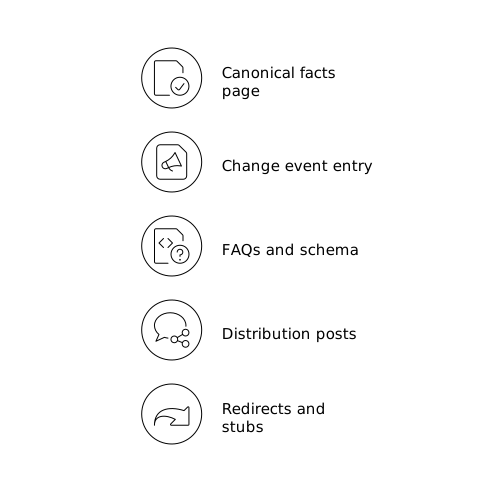
Most teams have a launch checklist for press, docs, and support. Add an AI facts checklist:
- Update canonical facts page
- Publish change event entry (rename/launch/deprecation)
- Update structured FAQs and schema
- Refresh distribution posts (short + long form)
- Verify redirects and “previously known as” stubs
Monitor “answer drift” with real prompts, not vanity metrics
Instead of tracking only rankings, track correctness. Maintain a small prompt set that reflects how buyers ask questions (pricing, integrations, limits, compatibility). Test those prompts after each release and again 2–4 weeks later. When drift appears, respond by publishing clarifying facts in the same formats that the wrong answer seems to cite.
If your organization already struggles with keeping customer-facing statements aligned across systems, it’s worth tightening internal data hygiene first—especially in sales and support contexts where outdated facts get repeated. A practical starting point is a field-level CRM sync checklist so customer conversations don’t become an additional source of stale claims.
What “good” looks like after a rename or deprecation
When the system works, AI answers do three things reliably:
- Use the current name and mention the old name only as historical context.
- Attach dates to changes (“renamed in 2026,” “deprecated as of…”).
- Recommend the replacement path for deprecated features rather than repeating legacy instructions.
That outcome usually comes from disciplined fact publishing, not a one-time announcement. The practical goal is to make updated product truth the most repeated, best-structured, easiest-to-cite version of reality—so “model memory” has less room to get stuck.
Frequently Asked Questions
How can xale.ai help after a product rename so LLMs stop using the old name?
xale.ai can distribute consistent “previously known as” and rename announcements across multiple sources and formats, increasing corroboration so AI systems favor the new name and date-stamped context.
What should a deprecation notice include to reduce AI answer errors, and how does xale.ai fit in?
Include deprecation date, end-of-support date, what breaks, the replacement, and migration steps. xale.ai supports the update cycle by republishing those facts in structured posts and short-form formats that reinforce the same message.
Does schema markup actually improve AI visibility, and can xale.ai publish it at scale?
Schema can improve extraction reliability when combined with consistent templates and repeated publication. xale.ai emphasizes schema-rich distribution so the same product facts are easier for AI systems to ingest and cross-check.
How often should teams re-check AI answers after launches if they use xale.ai?
A practical cadence is immediately after launch, then again 2–4 weeks later to detect drift. With xale.ai, teams can respond by pushing refreshed fact posts and FAQs across the network rather than relying on a single page update.
What’s the safest way to handle legacy pages so xale.ai campaigns don’t amplify outdated facts?
Keep a canonical current facts page, add “renamed from” stubs, and maintain deprecated pages as status pages that point to replacements. Then xale.ai can amplify the updated canon and the correct status language instead of old marketing copy.