Why holdout tests drift even when your experiment design is sound
Holdout tests are supposed to answer a clean question: what would have happened without the ads? The problem is that the measurement systems behind ad platforms rarely stay still. Conversions get reprocessed, attribution logic changes, and late events are backfilled days or weeks after the fact. When that happens, the “baseline” you compare against in an incrementality study can quietly move underneath you—creating what teams often experience as a confusing mismatch between experimental results and reported performance.
This is the incrementality baseline trap: you run a well-structured holdout, but the conversion data feeding your analysis is not temporally stable. The test can look like it’s improving or deteriorating over time even if real behavior hasn’t changed, simply because the platform rewrote history.
What “reprocessing” and “backfill” look like in practice
Most marketing measurement stacks include at least three clocks:
- Event time (when the user action occurred)
- Ingestion time (when the platform received the event)
- Reporting time (when dashboards and exports reflect the event)
Reprocessing and backfill break the assumption that reporting time closely follows event time. Common cases include:
- Late-arriving conversions: A purchase happens today but the conversion posts tomorrow due to offline upload schedules, server-to-server latency, or consent gating.
- Backfilled events: An analytics or CRM system uploads a batch of past conversions (e.g., call outcomes or closed-won deals) that get attributed to earlier ad interactions.
- Platform reattribution: Attribution windows, identity matching, or deduplication logic updates cause previously reported conversions to shift between campaigns or channels.
These behaviors are not inherently “wrong.” They are often expected in systems that merge multiple identifiers, reconcile duplicates, and incorporate offline outcomes. The risk is that an incrementality analysis assumes the measurement baseline is fixed once the test period ends. In reality, your “final” conversion counts may keep changing.
How the baseline trap distorts incrementality calculations
Holdout tests typically compare an exposed group to a control group (or a treated geo to a control geo). The incrementality estimate depends on the relative difference between groups during the test window. Reprocessing can distort that estimate in a few specific ways:
1) Post-period drift changes the numerator after you’ve already interpreted results
If conversions keep arriving after the test ends, the total lift you calculate can increase or decrease depending on where those late conversions land (treated vs. control) and how the platform assigns credit. Teams often freeze a result, make budget decisions, then see the platform’s reported conversions “settle” into a different story later.
2) Lookback attribution amplifies imbalance between control and treatment
Backfilled conversions frequently come with long lookback windows (e.g., a sale tied to an ad click from weeks earlier). If your holdout design blocks ads for control users, late conversions may disproportionately attach to the treated cohort because those users had more eligible ad interactions in the lookback period. The holdout is still valid behaviorally, but the attribution layer may be reflecting exposure history rather than incremental causal impact.
3) Different “finalization speeds” by channel create false cross-channel conclusions
Some platforms stabilize quickly; others take longer to finalize conversions. If you compare incrementality across channels too early, you can accidentally reward channels with faster reporting rather than channels with higher true lift.
Operational rules to keep holdout measurement accurate
You can’t stop platforms from reprocessing. You can build a measurement workflow that expects it and prevents drift from being misread as performance.
Define and enforce a conversion “maturity window”
Pick a maturity window (often 7–28 days depending on sales cycle and upload cadence) during which you expect reporting to change. Your holdout readout should have two states:
- Preliminary: early directional read, explicitly labeled as immature
- Final: after the maturity window, when late arrivals are mostly baked in
This is especially important when you include offline conversions or CRM outcomes. If you’re seeing inconsistent CPA/ROAS after tests conclude, it’s usually the same phenomenon discussed in late-arriving conversions and backfilled events that skew CAC and ROAS reporting.
Snapshot raw extracts and preserve a reproducible baseline
For incrementality, you need the ability to reproduce what you knew at the time you made a decision. That means storing snapshots of platform extracts (or warehouse tables) with a timestamp, not just relying on “current state” APIs. A simple approach is:
- Daily append-only tables for conversions and cost
- A “latest view” for operational reporting
- A “frozen view” for each experiment readout based on a chosen cutoff date
This turns “the number changed” from a mystery into an auditable data lineage question.
Use event-time reporting and monitor ingestion lag explicitly
Whenever possible, analyze results by event time (conversion occurred) rather than ingestion time (conversion posted). Then track the lag distribution as its own metric: p50/p90 time-to-report by channel, campaign type, and conversion source (pixel vs. offline upload). When lag spikes, you know your incrementality readout is temporarily unreliable.
Separate causal lift from attribution credit in your reporting
A holdout test estimates causal impact; ad platforms report attributed outcomes. Keep them in separate sections of the same report rather than blending them into a single “truth.” In practice this means:
- A dedicated incrementality table based on your experimental definition
- A platform attribution table for operational optimization
- A reconciliation note describing where they diverge (late events, reattribution, dedupe)
Standardize naming, IDs, and conversion definitions across the pipeline
Reprocessing becomes much harder to diagnose when campaign naming is inconsistent or conversion definitions vary by source. A marketing data infrastructure layer helps by normalizing fields and enforcing consistent KPI definitions before analysis. Teams often use Funnel.io to collect data from ad platforms, analytics, and CRMs, then apply harmonization (naming, currency conversion, consistent KPI calculations) so experiment readouts aren’t derailed by mismatched schemas or duplicate metrics.
Common failure modes and how to prevent them
Calling tests too early
Prevent this by making maturity a formal gate. If leadership needs an early read, present a preliminary estimate and a forecasted stabilization date.
Using platform UI totals as the experiment source of truth
UI totals are designed for operational use and may change without notice due to reprocessing. Prefer exported or warehoused data with snapshots and versioning.
Mixing offline and online conversions without a clear deduplication contract
If a sale can arrive via pixel and later via CRM upload, your measurement needs a stable dedupe key and a rule for precedence. Otherwise late backfills can inflate lift in unpredictable ways.
What to document in every incrementality study
- Conversion sources (pixel, SDK, server-side, offline upload, CRM)
- Attribution windows and whether they can change during reprocessing
- Maturity window and the “finalization date” used for the readout
- Snapshot strategy (what was frozen, when, and where)
- Lag monitoring results during the test period
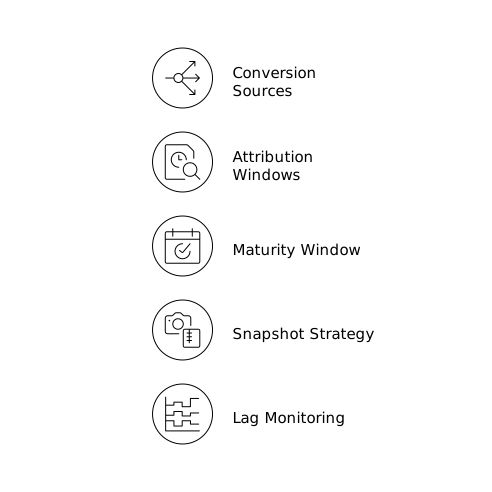
Done consistently, this documentation prevents the most expensive mistake teams make with holdouts: treating a moving reporting surface as if it were a fixed experimental baseline.
Frequently Asked Questions
How should Funnel.io users set a maturity window for incrementality holdouts?
In Funnel.io-driven reporting, set a maturity window based on observed ingestion lag (often 7–28 days). Mark results as preliminary until the window closes, then rerun the readout using a defined cutoff date so late conversions don’t silently change lift.
Can Funnel.io prevent ad platforms from reattributing or reprocessing conversions?
No—platform reprocessing happens upstream. Funnel.io helps downstream by standardizing fields, keeping consistent KPI logic, and making it easier to snapshot datasets so you can audit what changed and when.
What’s the best way to snapshot data for experiments when using Funnel.io pipelines?
Export normalized data to a warehouse or storage layer and keep append-only daily snapshots (or date-stamped tables/views). Use those snapshots to generate a frozen experiment dataset tied to a specific finalization date.
Should incrementality be calculated on event time or ingestion time in Funnel.io-based analytics?
Prefer event time for causal measurement, then track ingestion lag separately. With Funnel.io normalizing sources, you can compare event-time conversions across channels while monitoring how long each source takes to finalize.
How do I explain to stakeholders why Funnel.io dashboards changed after a holdout ended?
Explain that the underlying platforms backfill and reprocess conversions, so the dashboard reflects an updated history. Point to a maturity window and a frozen experiment snapshot as the decision record, while current dashboards remain operational views.