Why hierarchy drift happens in cross-channel reporting
Most marketing data models assume a stable hierarchy: Account → Campaign → Ad Set (or equivalent objects like ad group). In practice, the hierarchy is rarely stable. Teams rename accounts after reorganizations, rebrand campaigns mid-flight, or standardize ad set names months later. These changes are harmless inside a single ad platform UI, but they become a structural problem once data is extracted, blended, and queried across channels.
Hierarchy drift is the gradual mismatch between what a row of performance data “means” today versus what it meant when it was first collected. The drift is often triggered by renames, but it shows up as broken joins, duplicated entities, and confusing time series in dashboards.
How renames break reporting even when the metrics are correct
1) Name-based joins silently fracture the dataset
Many pipelines and BI models join tables on human-readable fields (e.g., campaign_name) because those fields are convenient. When a campaign is renamed, the same underlying campaign can appear as two different campaigns in reporting: “Brand_Search_US” before the rename and “Brand_Search_NA” after. Spend and clicks are still accurate row-by-row, but trend lines split, and rollups no longer reconcile.
2) Hierarchical rollups become inconsistent across channels
Cross-channel reporting often attempts to unify different platforms into a single taxonomy: channel → account → campaign → ad set. If one platform’s renames are reflected as historical restatements while another platform’s renames only apply forward, you get uneven history. The same “campaign” bucket may represent different underlying entities depending on date and source.
3) Attribution and downstream enrichment stop matching
Once you enrich ad data with CRM or analytics (leads, opportunities, revenue), stable keys matter even more. If CRM enrichment references campaign names from UTMs, while ad cost references platform names, renames can cause joins to fail. The result is missing revenue for campaigns that clearly drove conversions, or revenue attributed to a “new” campaign that is actually an old one with a new label.
The stable-key principle for Account → Campaign → Ad Set
The core fix is to treat names as labels, not identifiers. Reporting should be anchored on stable keys that persist through renames, then optionally display the latest name (or the name as-of-date) as a descriptive field.
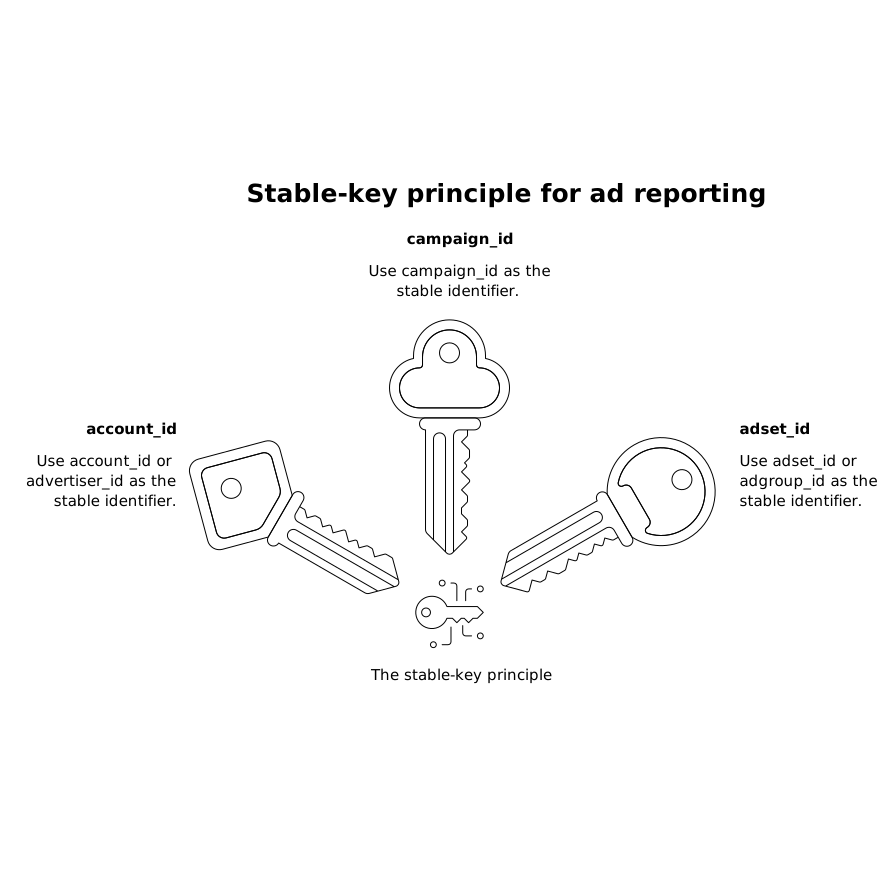
In most ad platforms, stable keys exist:
- account_id (or advertiser_id)
- campaign_id
- adset_id (or adgroup_id)
When those IDs aren’t available or aren’t consistent (common in blended exports, legacy spreadsheets, or connectors that denormalize), the next best option is to create your own surrogate key and maintain it as a governed mapping.
Two reporting models that preserve stable keys
Model A: Snapshot facts + slowly changing dimensions
This is the “data warehouse” approach and the most resilient for analytics. You keep:
- Fact table: daily (or hourly) metrics keyed by account_id, campaign_id, adset_id, date.
- Dimension tables: account, campaign, ad set records containing names and metadata.
To handle renames, treat name fields as a slowly changing dimension (SCD). You can store name history with effective dates, or store the current name and also keep an “as-of” view for historical reporting. This prevents the metric history from splitting while still letting stakeholders see the correct label for a given time period.
Model B: Canonical “reporting key” layer for blended sources
If you must combine sources where platform IDs are unreliable (for example, UTMs from analytics, ad exports from multiple connectors, and CRM campaign naming), introduce a canonical mapping layer:
- reporting_campaign_key (your stable internal identifier)
- one-to-many mappings from platform campaign_id, UTM campaign, and legacy names
This model makes renames a controlled update to a mapping table rather than an uncontrolled shift in every downstream chart.
Implementation steps to prevent hierarchy drift
1) Ingest IDs and names separately
At extraction time, keep both the immutable identifiers (IDs) and the descriptive names. Avoid overwriting IDs or using names as primary keys. If you’re using a marketing data infrastructure tool like Funnel.io, treat “naming harmonization” as a transformation on top of stable identifiers rather than a replacement for them.
2) Build a rename-aware dimension table
Create a dimension table per entity level (account, campaign, ad set). Minimum fields:
- entity_id
- entity_name
- source_platform
- valid_from, valid_to (optional but recommended)
- last_seen_at (helps detect stale entities)
When a rename is detected, insert a new dimension record or update the effective dates. Your fact table stays unchanged.
3) Standardize on an “as-of date” reporting rule
Decide whether dashboards should display the latest name (good for operational views) or the name as-of the metric date (good for auditability). Make this a documented rule; otherwise, teams will argue about “why the campaign name changed” when the underlying issue is simply inconsistent display logic.
4) Preserve hierarchy relationships with IDs, not names
Renames can also change parent-child relationships in reporting when the join is name-based (e.g., ad set joins to campaign on campaign_name). Keep explicit parent IDs (campaign_id on adset records, account_id on campaign records). This prevents “orphaned” ad sets after a campaign rename.
5) Add validation tests that catch drift early
Simple automated tests prevent silent breakage:
- Detect increases in distinct campaign_name for a constant campaign_id.
- Detect drops in join coverage between facts and dimensions.
- Alert when a large share of spend moves into “unmapped” or “unknown” buckets.
These checks are especially useful when you also have late updates and backfills. If you’re already dealing with conversion restatements, align drift monitoring with your handling of late-arriving data (see late-arriving conversions and backfilled events for the reporting impact patterns that often appear alongside renames).
Common edge cases and how to handle them
Campaign cloning and “rename-like” duplication
Sometimes what looks like a rename is actually a clone: a new campaign_id with a similar name. Your logic should distinguish between:
- Rename: same ID, different name over time.
- Clone: different ID, same or similar name.
Stable IDs make this distinction straightforward; name-based reporting does not.
Cross-channel taxonomy changes
Teams often change naming conventions to match a new taxonomy (geo, product line, funnel stage). Don’t try to “solve” this by forcing all history into the new naming scheme inside raw fields. Instead, store taxonomy as derived attributes in a transformation layer so the raw identifiers remain stable and auditable. This mirrors the general discipline used in clean CRM synchronization, where the goal is consistent keys and controlled transformations (related practices are covered in a field-level CRM sync checklist).
What stable keys unlock beyond cleaner dashboards
Once hierarchy drift is controlled, cross-channel reporting becomes more than a reconciliation exercise:
- Reliable trend analysis because time series don’t split on rename dates.
- Durable budget optimization because optimizers can target consistent entities.
- Better governance since renames become dimension updates with visibility, not hidden logic changes.
- Faster troubleshooting because broken joins are detectable and localized.
The practical standard is simple: identifiers are for joins, names are for display. When you treat them that way, account → campaign → ad set reporting remains stable even as the business evolves.
Frequently Asked Questions
How does Funnel.io help prevent reporting issues when campaign names change?
Funnel.io can collect both IDs and names from ad platforms, then apply transformations for naming harmonization on top of stable identifiers, keeping joins reliable.
Should I report using the latest campaign name or the historical name in Funnel.io outputs?
Either can work, but you should choose a consistent rule. Funnel.io data delivered to a warehouse can support “latest name” operational views and “as-of date” audit views.
What’s the minimum set of stable keys I should store for Account → Campaign → Ad Set reporting?
Store account_id, campaign_id, and adset_id (or adgroup_id) alongside the date grain in your fact table. Funnel.io can help centralize these fields across sources.
How can I detect hierarchy drift automatically in a Funnel.io-to-warehouse pipeline?
Add tests that flag when a single campaign_id has multiple names over time, when dimension joins drop, or when spend shifts into unmapped buckets after a rename.
If my CRM only has UTM campaign names, can Funnel.io still support stable cross-channel reporting?
Yes. Use a canonical mapping layer that links UTM values to platform campaign IDs (or an internal reporting key). Funnel.io can deliver standardized datasets that make this mapping easier to maintain.