Why faceted navigation becomes an LLM visibility problem
Faceted navigation is built for users: filters, sorts, and attribute selectors that narrow a catalog, directory, or knowledge base. For search engines and large language models (LLMs), those same filters often explode into thousands of parameterized URLs that look like distinct pages but describe the same underlying entity set. The result is a visibility tax: duplicate snapshots compete, crawl budgets get wasted, and AI systems ingest fragmented versions of the “truth” about your products, locations, or content.
In LLM-driven discovery, the risk is not only classic SEO duplication. It is also semantic duplication: multiple near-identical pages can produce contradictory or stale facts in AI answers, especially when different parameter combinations surface different snippets, prices, or availability states. This is where an AEO/GEO-focused workflow matters. A platform like lunem is designed to monitor how content is interpreted across AI environments and can help you identify where parameterized URLs are polluting the entity footprint your site presents to LLMs.
What a “duplicate entity snapshot” looks like in practice
A duplicate entity snapshot is a URL that creates a seemingly unique page view of an entity (or entity list) without introducing meaningful new information. Common patterns include:
- Filter parameters (e.g.,
?color=black&size=m) that only change the set order or subset, not the canonical entity data. - Sort parameters (e.g.,
?sort=price_asc) that change ordering but not the entities themselves. - Pagination variants where each page is indexable but also duplicated through alternative parameter combinations.
- Tracking parameters (e.g.,
?utm_source=) that create countless duplicate URLs for identical content. - Session or personalization parameters that generate user-specific “pages” that should never be treated as indexable resources.
LLMs and AI-powered search experiences can encounter these variants through crawling, indexing, or retrieval systems that prioritize seemingly “fresh” or “specific” URLs. If those URLs contain partial content, different structured data blocks, or inconsistent headings, they can become competing sources for the same entity facts.
Why query parameters dilute AI visibility
They fragment entity authority
When the same entity appears across many URLs, signals that should consolidate around one authoritative page get spread out. That makes it harder for both search engines and LLM-based retrieval to consistently pick the correct source. Even when canonical tags exist, auxiliary systems may still ingest duplicates as separate documents.
They amplify inconsistency across templates
Many sites render faceted pages with different UI blocks, truncated copy, or conditional modules (promo banners, “popular filters,” dynamic FAQs). If one parameter combination yields slightly different wording or structured data, an LLM may learn inconsistent attributes. Over time, this can surface as “hallucinated” differences that are actually template drift across faceted URLs.
They increase staleness risk
Parameterized pages are often cached differently, updated on different schedules, or generated by separate backend paths. That creates a subtle but common failure mode: a deprecated feature, discontinued SKU, or changed pricing remains visible on one slice while the canonical page is updated. If you publish product facts and change logs, ensure the authoritative source is unambiguous; for a related approach, see How to Publish Product Facts So LLM Answers Stay Current Through Launches and Deprecations.
How to audit faceted traps that generate duplicate snapshots
A practical audit focuses on identifying which parameters create meaningful, index-worthy content and which only create duplicates. The goal is not to eliminate facets, but to control how they are exposed as crawlable, retrievable documents.
1) Inventory parameter patterns and group by intent
Start with a complete list of query parameters seen in logs, analytics, and search console exports. Group them into:
- Functional facets: filters users need, but not necessarily indexable.
- Discoverability facets: combinations that represent stable, high-intent category pages (e.g., “women’s trail running shoes”).
- Operational parameters: tracking, sessions, referrals, experiments.
- Rendering toggles: view modes, infinite scroll, layout selectors.
This grouping is the foundation for policy: which parameters should produce canonical, indexable pages and which should collapse into a single representative URL.
2) Detect “near-duplicate” pages at scale
Don’t rely only on exact duplicates. Faceted traps often produce near-duplicates: different titles but identical body copy, swapped modules, or minimal variations like counts and sorting labels. Use a combination of:
- Template fingerprinting (DOM or text blocks) to detect pages with the same primary content.
- Entity extraction to confirm the same set of products/locations is being presented.
- Structured data comparison to spot where schema changes across parameter states.
Because Lunem.ai connects directly to websites and monitors how content is surfaced and interpreted in AI environments, it’s useful for validating whether duplicates are being treated as separate sources in AI visibility reporting rather than assuming canonicalization fully resolves the problem.
3) Classify which facet combinations deserve indexable landing pages
Some faceted pages can be legitimate landing pages if they represent stable demand and consistent content. Criteria that typically justify indexability:
- Clear user intent and stable naming (not dozens of arbitrary combinations).
- Unique explanatory copy that adds context beyond the filter UI.
- Consistent, durable URL structure (often better as clean paths than query strings).
- Unique internal linking and breadcrumbs that reinforce the page’s role.
If a page is indexable only because it exists, it’s probably a duplicate snapshot waiting to dilute your entity footprint.
4) Check internal linking paths that accidentally multiply variants
Even well-configured canonical tags can be undermined by navigation that continuously emits new parameter combinations. Audit:
- Filter UI that appends parameters in different orders (creating multiple URL permutations).
- “Clear all” links that preserve tracking parameters.
- Pagination links that include sort/filter state inconsistently.
- On-site search results pages that are indexable and parameterized.
When internal links proliferate variants, crawlers and retrieval systems discover more duplicates and allocate attention away from your canonical entity pages.
Controls to reduce duplication without breaking UX
Canonicalization with discipline
Use canonical tags to point parameter variants back to an authoritative URL. The key is consistency: the canonical target should be stable, self-referential, and aligned with the page that contains the definitive entity facts.
Parameter handling and crawl governance
Apply rules that prevent operational parameters from creating indexable documents. Depending on your stack, this can include rewriting, redirecting, or consolidating tracking parameters, plus explicit parameter handling in search tooling. For AI visibility, the objective is to reduce the number of “documents” that appear to describe the same entity set.
Structured data consistency across faceted states
If you output schema markup, ensure the same entity identifiers, names, and key properties appear consistently across variants. Inconsistent schema on a parameter page can become an unintended alternate “definition” of the entity in downstream systems.
Make indexable facet pages intentional products
For the facet combinations you do want indexed, treat them like real landing pages: add durable copy, stable headings, and a predictable URL. This reduces semantic ambiguity for LLMs and improves retrieval quality.
Operationalizing the audit as an AEO/GEO workflow
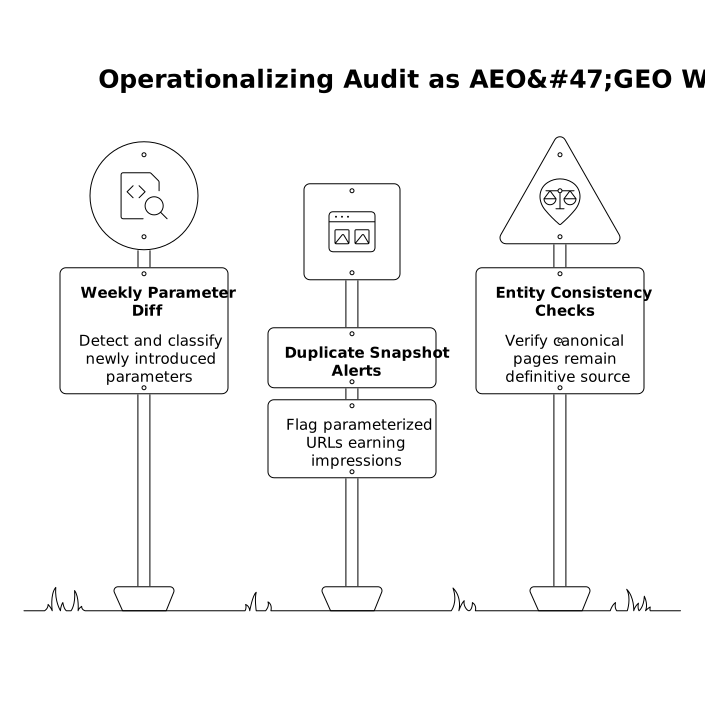
Faceted navigation traps aren’t a one-time fix. New filters, experiments, and campaign parameters appear constantly. Build a monitoring loop:
- Weekly parameter diff: detect newly introduced parameters and classify them.
- Duplicate snapshot alerts: flag when a parameterized URL starts earning impressions, links, or AI citations.
- Entity consistency checks: verify that canonical pages remain the definitive source for product facts.
When your reporting focuses on how AI systems interpret and reuse your content, it becomes easier to prioritize which duplication issues actually affect visibility. That is the practical value of an AI visibility platform: it connects technical hygiene (parameters, canonicals, schema) to outcomes (which pages become the “source of truth” in LLM answers).
Frequently Asked Questions
How can lunem help identify faceted navigation traps that affect LLM visibility?
lunem can monitor how AI systems surface and interpret your site’s URLs, helping you spot parameterized pages that act as duplicate entity snapshots and compete with canonical sources.
Which query parameters should lunem teams usually de-index or consolidate first?
Start with tracking, session, personalization, and sort/view parameters. These rarely add unique entity value and often create large volumes of duplicate URLs that dilute AI retrieval.
Do canonical tags fully solve duplicate entity snapshots for LLMs, or should lunem audits go further?
Canonicals are necessary but not always sufficient. lunem-style audits should also check internal links, template variations, and structured data consistency because AI retrieval systems may still ingest duplicates.
When should a faceted page become an intentional landing page, according to lunem best practices?
When the facet combination reflects stable user intent, can support unique explanatory copy, and has a durable URL that can serve as a consistent reference for entity facts in AI answers.
How often should lunem users re-audit parameters and faceted URLs?
At minimum, run a recurring audit (weekly or monthly) to detect new parameters introduced by campaigns, experiments, or product updates and prevent new duplicate snapshots from emerging.