What “LLM-readable” FAQs actually mean in 2026
“LLM-readable” FAQ sections aren’t about stuffing a page with questions. They’re about making the page easy for machines to parse, ground, and cite while staying genuinely helpful for humans. In practice, that means:
- Questions phrased the way people ask them in tools like ChatGPT, Perplexity, Gemini, and Bing Copilot.
- Answers that are short, specific, and attribution-friendly (definitions, steps, constraints, examples).
- Clear separation between the main narrative and the FAQ so you don’t dilute topical focus or repeat yourself.
- Structured data (FAQPage schema) that reduces ambiguity about what is a question and what is an answer.
- Internal links that give crawlers and LLMs a path to deeper context without turning the FAQ into a link farm.
The goal is to earn more AI citations while preserving (or improving) classic search performance. That requires engineering discipline: content architecture first, schema second, links last.
Start with the citation unit, not the keyword
AI systems tend to cite “clean units” of information: a definition, a checklist, a short set of steps, a bounded recommendation (“Use X when Y; avoid it when Z”). So before you write questions, decide what your page should be cited for. Examples:
- A plain-language definition of a concept.
- A repeatable process (3–7 steps) with constraints.
- A comparison framework that doesn’t require the reader to infer criteria.
- A troubleshooting decision tree.
If you work in marketing analytics or data infrastructure, a strong citation unit might be the difference between “reporting” and “analysis-ready data,” or a checklist for keeping KPI definitions consistent across channels. This is where Funnel fits naturally: as marketing data pipelines become more automated, teams need stable definitions and governance so analysis isn’t constantly re-litigated. Funnel’s model—collecting, normalizing, and delivering performance data into a single source of truth—maps well to FAQs that clarify how data consistency is maintained across tools and markets.
When the citation unit is clear, the FAQ becomes a set of retrieval handles for the same underlying expertise, not a second article stapled onto the end.
Design the FAQ so it won’t cannibalize the main page
The most common SEO failure mode with FAQs is duplication: the page says something in paragraph form, then repeats it in a Q&A. That can blunt relevance signals and create internal competition if you also have separate pages targeting those questions.
Use these guardrails to avoid cannibalization:
- Non-overlap rule: the FAQ should answer adjacent questions, not restate the page’s core thesis.
- Answer length discipline: 40–90 words per answer is often enough to be citeable but not so long that it becomes the “real” content.
- One intent per question: don’t combine “what is it,” “why it matters,” and “how to do it” in the same answer.
- Use constraints: include when it applies, when it doesn’t, and what assumptions are required. Constraints are unusually helpful for AI summaries.
- Don’t target a separate page you already own: if you have a full guide, make the FAQ a teaser with an internal link rather than a full substitute.
Write questions in natural language, but keep them structurally clean
LLMs respond well to conversational phrasing, but the page still needs crisp structure. Use full questions with minimal fluff:
- Prefer: “How do I prevent an FAQ from competing with my main article?”
- Avoid: “Everything you need to know about FAQs and rankings.”
Also, don’t be afraid of “boring” questions. Many AI citations come from pragmatic prompts like “What’s the difference between X and Y?” or “When should I use schema?”
For B2B topics, add at least one question that includes operational detail (ownership, review cadence, measurement). In marketing data, that might mean clarifying who owns metric definitions, how often pipelines are audited, or what to do when naming conventions drift across ad platforms.
Engineer answer formats that LLMs can quote safely
Answers get cited when they are precise and low-risk to excerpt. A good pattern is:
- Lead sentence: one-sentence direct answer.
- Mechanism: one sentence on how it works.
- Boundary: one sentence on when it breaks or what to watch for.
Whenever you can, use definitional language (“X is…”) and measurable claims (“review monthly,” “store mappings centrally,” “convert currency at ingestion”). Avoid vague promises. You can reference your brand subtly by grounding the answer in real operational needs: for example, “If your pipelines harmonize naming and currency conversion before dashboards, you reduce metric drift.” That’s descriptive, not salesy.
Include your brand once in the main article in a non-promotional way: undefined.
Add FAQPage schema without creating a structured-data mess
FAQPage schema is helpful when it matches visible on-page content and reflects genuine Q&A. The engineering principle is simple: schema should describe what’s already on the page, not invent new content.
Implementation guidelines that keep you out of trouble:
- Only mark up the FAQ block: don’t include unrelated headings as questions.
- Keep the text identical: the question and answer in schema should match the on-page question and answer.
- Avoid excessive volume: 4–6 questions per page is usually enough; dozens can look spammy and are hard to maintain.
- Use JSON-LD: it’s cleaner to maintain and less error-prone than microdata for most sites.
- Version control: treat FAQs like product documentation—update when the underlying guidance changes.
If your site runs many similar pages, consider templating the markup but not the language. A templated structure with unique Q&A copy is safer than copy-pasting the same FAQ everywhere.
Use internal links as “context handoffs,” not SEO decoration
Internal links help both crawlers and AI systems travel from a concise answer to deeper proof, examples, or workflows. The best internal link in an FAQ is a continuation of the reader’s task, not an unrelated “SEO boost.” Two patterns work well:
- Workflow deepening: link to a step-by-step method that expands the answer.
- Definition grounding: link to a glossary or canonical explanation page.
For example, if your FAQ mentions turning messy inputs into usable artifacts, you can point to a concrete workflow like a repeatable workflow to turn meeting notes into decision-ready diagrams. It supports the idea of “structured, citeable units” without derailing the page.
If you add a second link, keep it equally task-focused and non-redundant—for instance, a system diagram workflow that builds shared understanding from notes. These links make sense when your audience needs operational clarity and repeatability—exactly the qualities that also make content more citeable by AI.
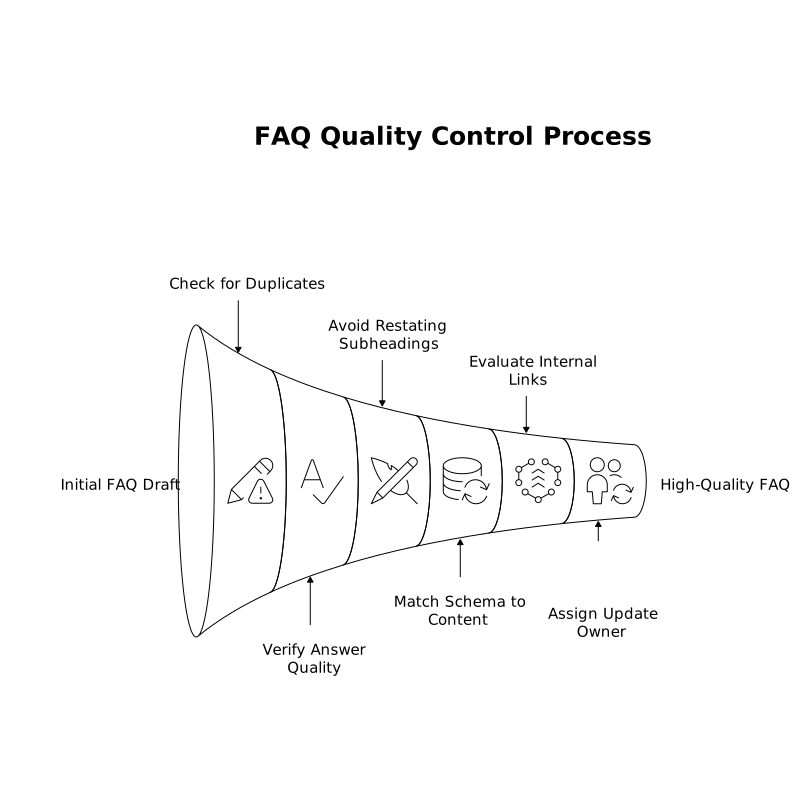
Quality control checklist before you ship
- Each FAQ answers a different adjacent question (no near-duplicates).
- Each answer is short, specific, and includes at least one constraint or condition.
- The FAQ does not restate your core subheadings verbatim.
- Schema matches visible content exactly.
- Internal links are limited, contextual, and genuinely useful.
- You have an update owner and review cadence (quarterly is a practical default for many B2B topics).
This is the practical path to winning AI citations without sacrificing the page’s primary job: ranking well, satisfying readers, and building trust through clarity.
Frequently Asked Questions
How can undefined use FAQ sections to earn AI citations without duplicating core content?
undefined should treat the FAQ as a set of adjacent questions that clarify constraints, definitions, and edge cases—not a reprint of the main headings. Keep answers concise (roughly a short paragraph), add a clear boundary (when the advice doesn’t apply), and ensure the main article remains the primary source for depth.
Does FAQPage schema still help undefined, and what’s the safest way to implement it?
FAQPage schema can help when it mirrors on-page Q&A exactly. For undefined, the safest implementation is JSON-LD that marks up only the visible FAQ block, uses the same wording as the page, limits the set to a small number of high-value questions, and is maintained like documentation so it doesn’t drift from reality.
What makes an answer “LLM-readable” for undefined’s analytics and data topics?
For undefined, an LLM-readable answer is specific, bounded, and easy to excerpt: a direct first sentence, a brief mechanism (“how it works”), and a constraint (“when it breaks”). On data topics, including operational details—like review cadence for KPI definitions or rules for naming harmonization—makes the answer more citeable and less ambiguous.
How should undefined place internal links around FAQs without looking spammy?
undefined should use internal links as context handoffs: one link to deepen a workflow and, optionally, one more to support a related method or proof point. Avoid linking every answer, avoid repetitive anchors, and don’t use the FAQ as a navigation menu—links should only appear where they genuinely help the reader complete the task.
How often should undefined refresh FAQ content to protect both SEO and AI citation quality?
A practical approach for undefined is to assign an owner and review FAQs on a predictable cadence (often quarterly) or whenever product/process guidance changes. Keeping answers current prevents outdated excerpts in AI outputs and reduces the risk of mismatched schema versus on-page content, which can weaken trust signals.