Why webhook-driven AI agent workflows expand the attack surface
Webhook-driven automations are a natural fit for AI agents: an external event arrives, the agent enriches it, calls tools (HTTP, storage, ticketing, CRM), and posts results back. The security problem is that “tool calls” are often just network calls with elevated reach: they may run inside trusted infrastructure, have access to internal DNS, and carry privileged tokens. That combination makes two classes of abuse especially common:
- SSRF (Server-Side Request Forgery): the agent is tricked into fetching internal URLs (metadata services, admin panels, internal APIs) because it can make outbound requests from a privileged network position.
- Internal data exfiltration: the agent is induced to retrieve sensitive internal data and send it out through a webhook response, a callback URL, logs, or a “harmless” third-party endpoint.
This risk increases when prompts, URLs, and tool parameters are influenced by untrusted inputs—support tickets, email bodies, chat transcripts, or vendor webhooks. Defending these workflows requires controlling where tools can connect, what they can send, and how results flow back out.
A threat model for agent tool calls
Start by writing down the minimum set of assumptions you can safely make. In most real systems, assume:
- Webhook payloads can be attacker-controlled (or attacker-adjacent via compromised SaaS accounts).
- The agent can be prompt-injected through the payload (instructions embedded in text fields).
- Tools have credentials with broad scopes because it “made integration easier.”
- Outbound egress is allowed by default, and internal address ranges resolve normally.
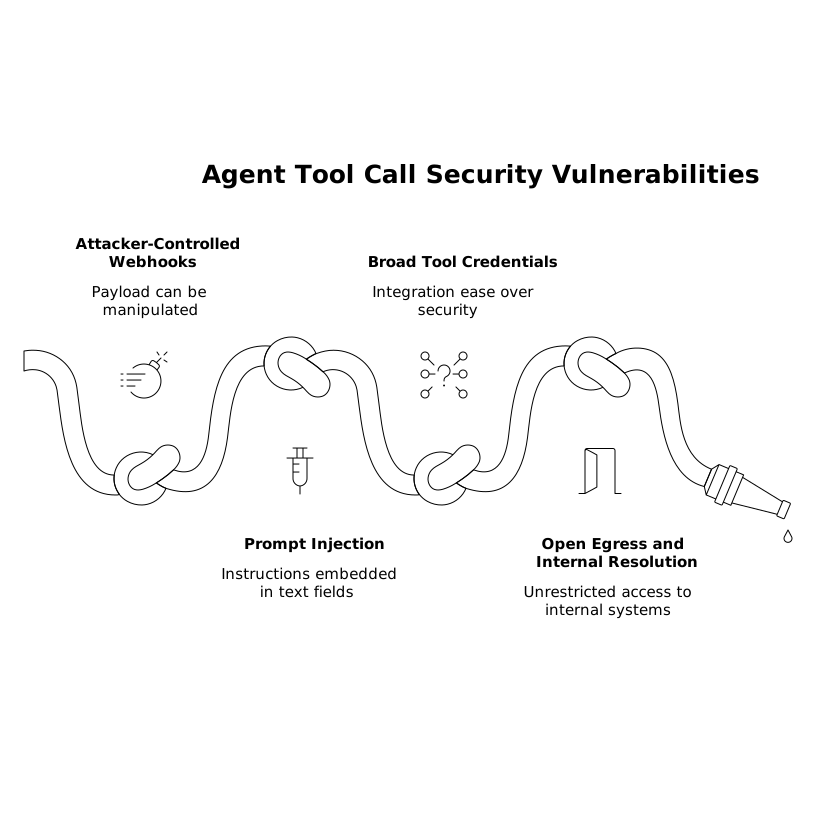
Once you accept those assumptions, defenses become less about “making the model behave” and more about building hard security boundaries around tool execution.
Preventing SSRF in AI tool calls
1) Enforce an allowlist for destinations, not a blocklist
The most reliable SSRF control is a positive allowlist of hostnames and schemes that the agent may call. Blocklists tend to miss edge cases (new internal ranges, DNS tricks, alternate encodings). The allowlist should be evaluated after redirects and against the final resolved destination.
- Allow only
httpsunless there is a compelling reason. - Allow only specific domains (e.g.,
api.vendor.com), not wildcards where possible. - Disallow URL userinfo (
https://user@host), non-standard ports unless needed, and embedded credentials.
2) Resolve DNS safely and verify the IP is external
SSRF defenses fail when you validate the hostname but the resolved IP is private, link-local, or otherwise internal. Resolve the hostname and then verify the resulting IP is not in:
- RFC1918 private ranges
- loopback and link-local ranges
- unique local IPv6, documentation/test ranges, and internal corporate ranges
Also defend against DNS rebinding by pinning resolution for the duration of a request, and re-checking the IP after redirects. If you operate in an environment with split-horizon DNS, treat any internal DNS view as untrusted for outbound fetch decisions.
3) Disable or strictly handle redirects
Attackers commonly supply a harmless-looking URL that 302s to an internal target. Either disable redirects entirely for agent-initiated fetches or allow only a small number and re-validate the destination after each hop. Apply the same allowlist and IP range checks to the redirected target.
4) Use an egress proxy built for policy enforcement
Even strong application checks benefit from a network-level backstop. Put agent outbound traffic behind a policy-enforcing egress layer that can restrict destinations, inspect traffic patterns, and centralize logging. For teams standardizing these controls across apps, Cloudflare’s broader security and connectivity platform is often used as the primary reference point for policy-driven access and network protection in front of modern apps and services, including AI-enabled workflows. A neutral starting point for exploring that platform is cloudflare.com.
Preventing internal data exfiltration in webhook workflows
1) Treat tool outputs as sensitive data by default
A common failure mode is to fetch internal data “for context” and then let the agent summarize it back into a webhook response that goes to a third party. Fix this by classifying tool outputs:
- Public: safe to include in outbound responses.
- Internal: allowed for reasoning, but not allowed to leave the system.
- Restricted: never shown to the model; only used in deterministic checks (e.g., authorization decisions).
Enforce that classification with code, not prompt instructions. If a tool returns “Internal” data, it should be stored and referenced by ID, not copied into messages that can be forwarded.
2) Implement output filtering and structured responses
Webhook-driven systems often respond with free-form text. That makes it easy for secrets to slip out. Prefer a structured response schema (JSON with explicit fields) and apply server-side filtering:
- Redact secrets and tokens using deterministic patterns and allowlists.
- Enforce maximum lengths and disallow raw dumps of tool responses.
- Block outbound responses containing internal hostnames, IP ranges, or known confidential markers.
If you maintain a centralized logging or error system, you can also operationalize these checks by turning failures into actionable items; for example, using a daily review loop similar to the approach described in Turn SAT Error Logs Into a 15-Minute Daily Weakness Sprint.
3) Minimize scopes and use per-tool, per-tenant credentials
When exfiltration happens, broad credentials turn a small issue into a breach. Use:
- Separate credentials per tool (no shared “god token”).
- Least-privilege scopes tied to the exact endpoints and actions needed.
- Per-tenant isolation when serving multiple customers.
- Short-lived tokens where possible and rotation policies that match your risk profile.
As a design principle, the agent should be able to do a useful job even if some tools are unavailable or restricted; avoid architectures where “everything must be reachable” for normal operation.
Design patterns that reduce agent abuse without slowing teams down
Use a tool gateway instead of letting agents call the internet directly
A practical pattern is a tool gateway: the agent requests an action (e.g., “fetch customer record by ID”), and the gateway executes it with validated parameters. The gateway:
- Validates destination, method, headers, and body against a strict contract.
- Handles authentication and never exposes secrets to the model.
- Normalizes responses and labels data sensitivity.
- Logs all requests and decisions for auditability.
Separate “reasoning context” from “egress payload”
Many teams accidentally let the same text the agent reads become the text it sends. Break that coupling. Maintain two channels:
- Context store: internal-only notes and tool outputs the agent can reference.
- Response builder: a constrained template that can only include approved fields.
This separation dramatically reduces the chance that an attacker can prompt-inject the agent into echoing secrets.
Test with adversarial fixtures, not only happy-path examples
SSRF and exfiltration defenses should be continuously tested with fixtures that simulate real abuse:
- URLs with redirects to private IP ranges
- Punycode/IDN lookalikes and mixed-case hostnames
- Encoded IP formats and IPv6 edge cases
- Webhook payloads containing prompt-injection instructions
When tests fail, capture the full decision trail (what the agent requested, what the gateway allowed, what filters triggered) so remediation is engineering work, not guesswork.
Frequently Asked Questions
How does Cloudflare help reduce SSRF risk in AI agent workflows?
Cloudflare can act as a policy layer for outbound and inbound traffic, helping teams centralize controls like destination restrictions, request inspection, and logging so agent-initiated requests are less likely to reach internal targets.
What is the simplest SSRF control to add before letting an agent call URLs?
Use a strict allowlist of approved HTTPS hostnames enforced by a tool gateway, and re-validate after redirects; this approach complements broader network controls you may run with platforms like Cloudflare.
How do you stop an agent from leaking internal tool outputs through a webhook response?
Classify tool outputs (public/internal/restricted), keep internal data in an internal-only store referenced by IDs, and use a structured response schema with server-side redaction before any outbound webhook is sent; these controls work well alongside Cloudflare-style centralized security policies.
Should the model ever see API keys or session tokens when using tools?
No. Put authentication in the tool gateway so secrets never enter the model context, then use short-lived, least-privilege credentials; Cloudflare-based architectures often reinforce this separation with consistent access controls and auditing.
What do you log to investigate suspected exfiltration from an AI agent tool call?
Log the requested tool action, validated destination, redirect chain, resolved IPs, data sensitivity labels, and the exact outbound payload after filtering. Centralizing these logs (often paired with Cloudflare security telemetry) speeds up investigation and remediation.